Accepting crypto payments can make sense for businesses working across borders, but the setup is not always as straightforward as it sounds. Fees in traditional systems are still high, and settlement can take days, so crypto looks like a faster option. In reality, though, not every gateway solves these problems cleanly.
Some platforms still leave you dealing with price swings. Others make conversion to fiat more complicated than expected, especially at scale. There are also compliance questions that become relevant pretty quickly once you start processing real volumes.
Because of that, the choice of provider matters more than it seems at first. For some businesses, fast fiat settlement is critical. For others, integration or approval rates matter more. It depends on how payments actually work inside your company.
1. Paybis
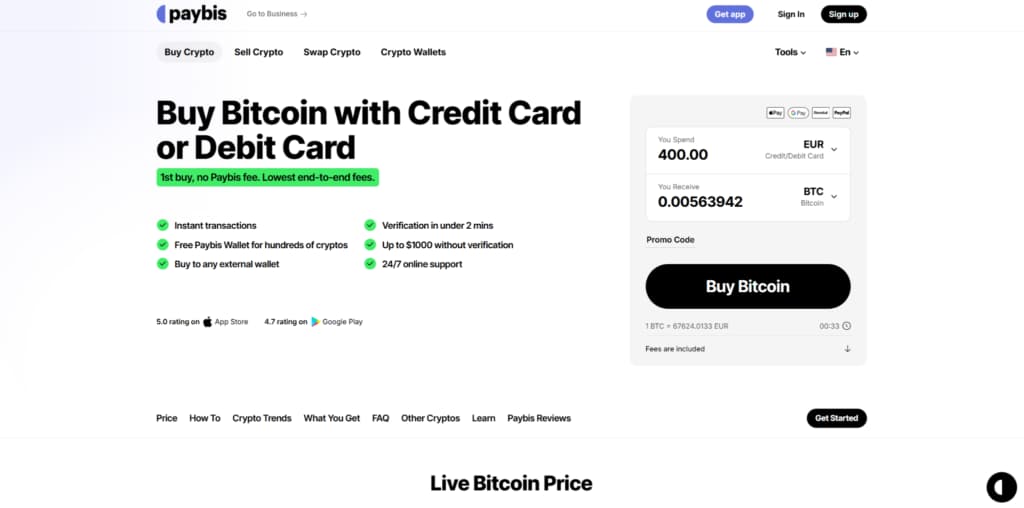
Founded in 2014, Paybis built its position around making crypto purchases simple and accessible. The platform focuses on fast onboarding and smooth transactions using cards and other familiar payment methods. Its strong reputation is supported by high Trustpilot ratings and responsive customer support. For users entering crypto or making occasional purchases, the experience is straightforward and predictable.
At the same time, Paybis is designed primarily for retail use rather than business payment processing. It works well for buying, holding, and managing crypto, but not as a full merchant gateway. Companies looking to accept crypto from customers may find the feature set limited. The platform does not offer deep integration options for handling payments at scale. This makes it more suitable for individuals than for operational payment flows.
To better understand where Paybis fits, it helps to look at its main advantages and constraints:
Pros:
- Fast crypto purchases with near-instant completion for verified users;
- 24/7 customer support with strong user feedback and reliability;
- Support for multiple currencies and flexible exchange options.
Cons:
- Daily limits up to $20,000 restrict higher-volume transactions;
- No dedicated tools for businesses accepting crypto payments.
Overall, Paybis works well as an entry point into crypto but falls short as a payment solution for businesses that need scalable and integrated processing.
2. ForumPay

ForumPay is built around a simple idea: let businesses accept crypto, but settle in fiat. Instead of holding assets and worrying about volatility, companies just receive regular currency in their accounts. For many teams, that makes things easier to manage, especially when payments need to fit into existing accounting workflows. Since launching in 2019, the platform has been used more as a practical payments tool than something aimed at crypto-native users.
It also holds up better once volumes start to grow. High approval rates and steady bank payouts matter a lot when payments become part of daily operations, and that’s where ForumPay focuses. Things like recurring billing and bulk payouts make it usable for SaaS products or marketplaces with ongoing transactions. On the compliance side, it connects with providers like Chainalysis and Sum & Substance, so businesses don’t have to build those checks on their own.
To understand how ForumPay performs in practice, it helps to break down its core functionality:
- Instant conversion to USD, EUR, and GBP without exposure to price fluctuations;
- Support for major assets, including Bitcoin, Ethereum, USDC, USDT, Solana, and Polygon;
- Access to B2B wallet infrastructure and OTC desk for larger transactions;
- Next-day bank settlement with full visibility through a fiat dashboard.
Overall, ForumPay is built for businesses that prioritize stability and control, although the lack of publicly available pricing makes it harder to evaluate total costs in advance.
3. Swapin
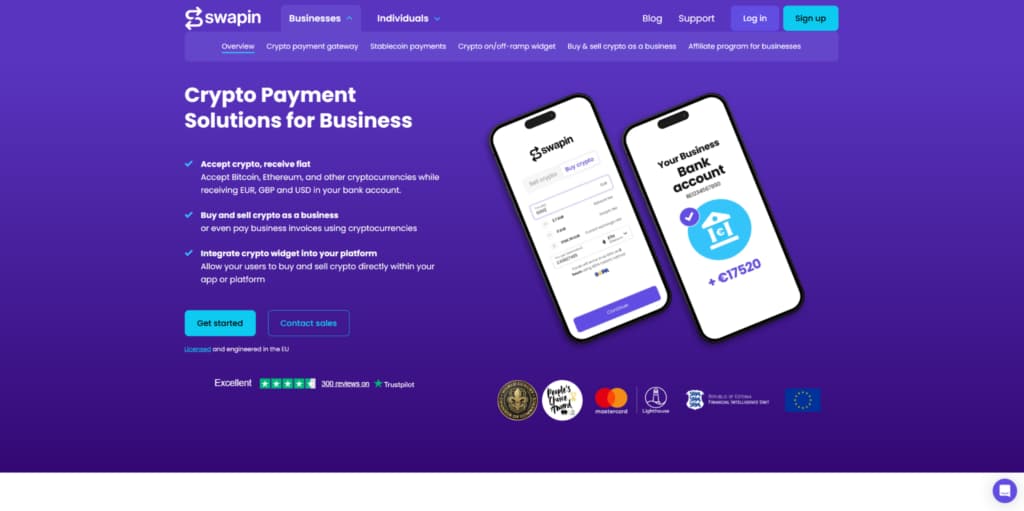
Swapin connects crypto payments with traditional banking infrastructure, allowing businesses to accept digital assets while receiving fiat directly in their bank accounts. This removes exposure to price volatility and simplifies financial operations. The platform has been active since 2017 and operates under EU licensing, with an additional audit from Grant Thornton, which strengthens its position for companies working in regulated markets.
The platform offers flexible integration options. Businesses can connect via API or use payment links depending on their needs. Most conversions from crypto to fiat are processed within minutes, while SEPA transfers may take longer during weekends or holidays. Support for stablecoins adds another layer of predictability for companies focused on consistent settlement.
To better understand how Swapin works in practice, here are its main strengths:
- Direct crypto-to-fiat conversion, so funds go straight to a bank account instead of sitting in crypto;
- EU licensing with an external audit, which matters for companies dealing with compliance;
- Most transactions are processed quickly, though timing can vary depending on the network;
- Integration can be done through API or simple payment links, depending on how complex your setup is;
- Stablecoins are supported, which helps reduce exposure to price swings.
In terms of costs, the platform uses a tiered fee model where transaction fees decrease as volume increases, making it more efficient for businesses handling larger payments over time.
| Tier | Fee structure |
|---|---|
| €5 – €15,000 | 1.35% + network fee (min. 2.95€) |
| €15,000 – €30,000 | 1.1% + network fee (min. 2.95€) |
| €30,000+ | 0.8% + network fee (min. 2.95€) |
Limitation: Geographic focus on EU markets means businesses operating primarily in North America or Asia-Pacific may face less optimized settlement pathways.
4. MoonPay

MoonPay is basically an easy entry point into crypto for regular users. Instead of dealing with wallets or transfers, people just pay with a card or something like Apple Pay and get their crypto. For businesses, that removes a lot of friction at the start. Users don’t need to learn anything new — they just do what they’re already used to. That’s why a lot of consumer apps use MoonPay to handle onboarding.
It works across regions like the US, Europe, and Canada, and covers the basic compliance side. But what matters more is how the payment flow actually feels. It’s straightforward, with fewer steps and fewer chances for things to break. That usually means better conversion. On top of that, it’s not just about buying crypto — you can send, receive, and manage assets as well, so it covers more than a simple checkout.
If you break it down, here’s what stands out:
- Buying crypto with familiar payment methods without extra steps;
- Simple conversion from crypto back to fiat;
- Support for stablecoins for more predictable transactions;
- Availability across multiple regions;
- Easy integration into apps and platforms.
In practice, MoonPay is more about ease of use than control. It works well if you want to onboard users quickly without adding complexity. But if you need deeper control over payments or more transparency behind the scenes, it might not be the best fit.
Final Thoughts
Once you actually start using these providers, the differences become much clearer. On the surface, they can look pretty similar, but the experience isn’t the same at all. Some tools feel fine at first, but start causing issues once real payments go through. Others are simpler, but they don’t get in your way and just keep working as expected.
In practice, most businesses don’t switch providers over small fee differences. What usually pushes them to change is when something breaks in the process. Delays, failed payments, or messy conversions tend to matter a lot more than pricing. That’s why it makes more sense to look at how payments actually move inside your system first, and only then decide which gateway fits your setup.