Scraping looks dead simple in controlled environments. You fire off a few requests, parse some HTML, and pat yourself on the back. Then production hits. Blocking systems slam the door. Dynamic content refuses to render. Scaling from a hundred requests to a hundred thousand breaks everything you thought you knew about web data extraction. The gap between tutorial code and real-world reliability is genuinely massive.
This article focuses on APIs that handle actual production conditions without falling apart. No theoretical performance claims. No “works on my machine” nonsense. The selection prioritizes reliability under pressure, automation of the tedious bits, and the ability to operate at scale when the target websites fight back. These are tools built for the ugly reality of modern web scraping.
Top 5 Web Scraping APIs That Handle Real-World Complexity
Not every scraping API is built for the same type of workload. Some focus on ease of use, others prioritize infrastructure depth or data extraction capabilities. The differences only become clear once scraping moves into real conditions, where blocking, dynamic content, and scale start to matter.
The tools below were selected based on how they handle those constraints in practice. Each one represents a different approach to keeping data pipelines stable when simple setups begin to fail.
1. HasData
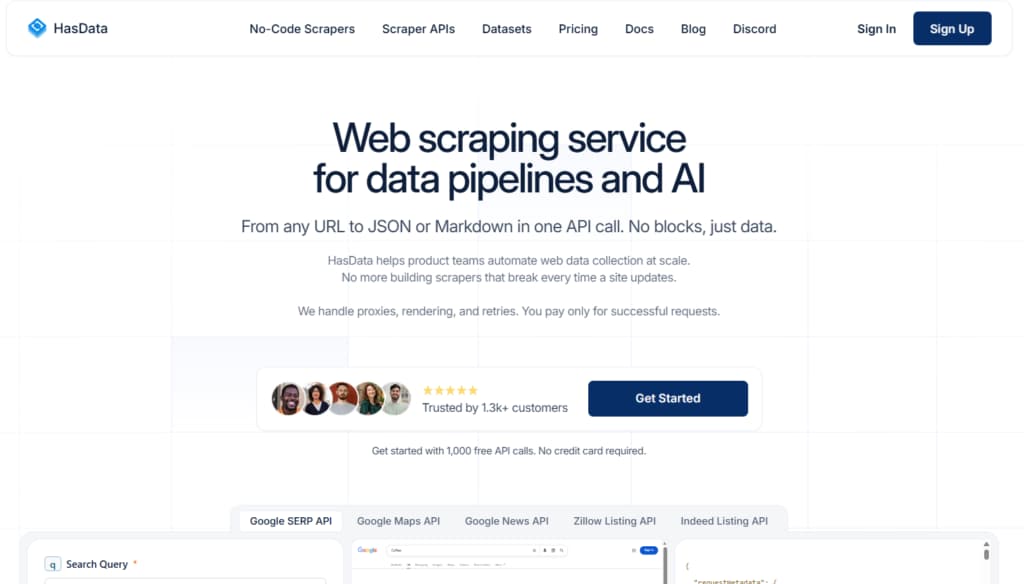
HasData focuses on large-scale scraping through a single API. It handles proxies, blocking countermeasures, dynamic content rendering, and page interactions internally instead of relying on separate tools. This becomes critical once scraping moves into production. Systems that fail due to IP blocks or rendering issues quickly turn into operational problems. HasData is built for environments where scraping needs to run consistently without constant manual fixes.
What Changes When Scraping Scales
Scraping at scale introduces problems that small-scale experiments never encounter. Anti-bot systems evolve constantly and detect patterns across thousands of requests. JavaScript-heavy pages require full browser environments rather than simple HTTP clients. Data extraction breaks when site structures change without warning. Manual setups fail over time because maintaining them demands resources most teams simply lack.
The API covers the full scraping workflow through:
- Single API call for large-scale data collection;
- Automatic proxy rotation across residential and datacenter IPs;
- Bypass of anti-bot protections such as Cloudflare and DataDome;
- JavaScript rendering for dynamic pages and SPAs;
- AI-based data extraction without custom selectors;
- Output in formats like JSON, HTML, or Markdown;
- Batch scraping of thousands of URLs;
- Page interactions like clicks, scrolling, and form filling.
This reduces the need for custom infrastructure and ongoing maintenance that drains engineering bandwidth.
Where It Makes the Most Sense
HasData fits teams scraping at scale, dealing with aggressive blocking, or needing structured data without building internal tooling from scratch. It works best in setups where scraping is part of ongoing operations, not a one-off task. Once data pipelines depend on consistent output, reducing maintenance overhead becomes more important than squeezing out marginal performance gains.
2. Bright Data
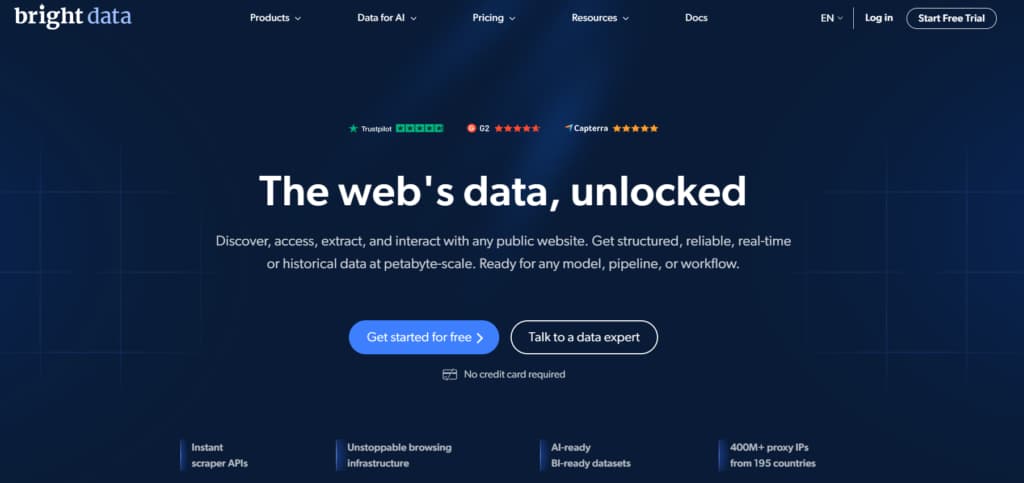
Bright Data focuses on large-scale data collection backed by a massive proxy infrastructure. The platform offers granular control over requests, targeting, and output formats. This level of flexibility appeals to companies with mature data pipelines. The tradeoff is complexity, as it requires a higher level of technical involvement.
Infrastructure That Handles Volume
High-volume scraping depends almost entirely on the underlying proxy network. Request control without quality IPs means constant blocking and incomplete datasets. Global coverage determines whether you can access region-specific content reliably.
Its strengths are built around:
- Large proxy network with global targeting;
- Advanced request configuration;
- High-volume scraping support;
- Tools for structured data extraction.
This setup is designed for enterprise-level scraping pipelines that demand consistency and configurability.
Best Use Cases
Bright Data fits companies with large-scale data needs and internal technical teams capable of handling complex configurations. It makes the most sense when control over request behavior and global targeting matter more than ease of use. Teams that can manage the added complexity get the flexibility that simpler APIs usually can’t provide.
3. ScrapingBee
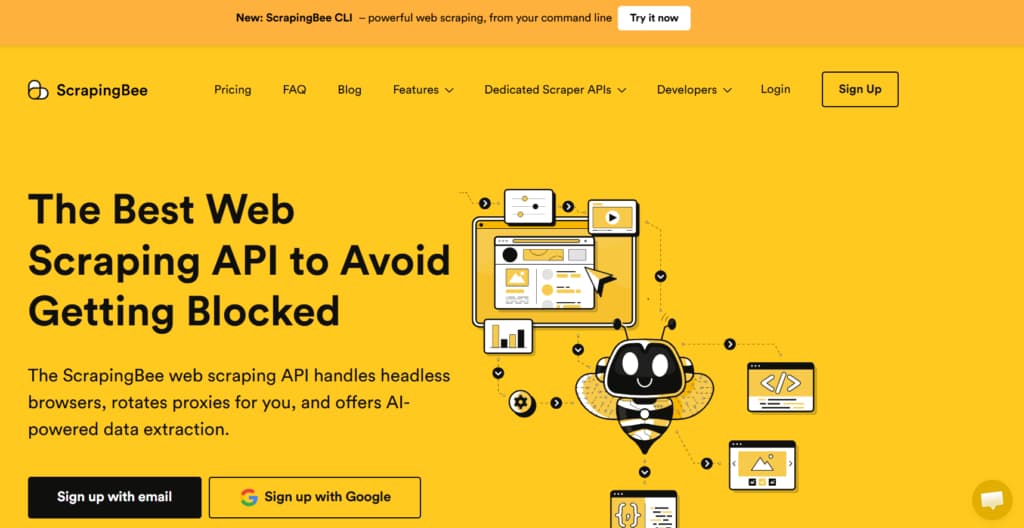
ScrapingBee simplifies scraping by combining proxy management and headless browser rendering into a single API. The main value is reducing setup complexity for teams that cannot maintain their own infrastructure. You send a request and receive fully rendered content without handling proxies or browser environments manually.
Simplifying Dynamic Page Scraping
Modern websites demand more than simple HTTP requests. JavaScript frameworks render content dynamically after initial page load. Proxies require rotation to avoid rate limiting and IP bans. Managing these components separately multiplies complexity exponentially.
The API simplifies this through:
- Built-in headless browser rendering;
- Automatic proxy management;
- Simple API integration;
- Support for JavaScript-heavy pages.
This reduces setup complexity for teams that need quick results without building custom infrastructure.
Where It Works Best
ScrapingBee fits smaller teams or projects that need fast implementation and stable results without building custom infrastructure. It works well when scraping is a supporting function rather than a core system. In these cases, reducing setup time often matters more than having full control over every request.
4. Oxylabs
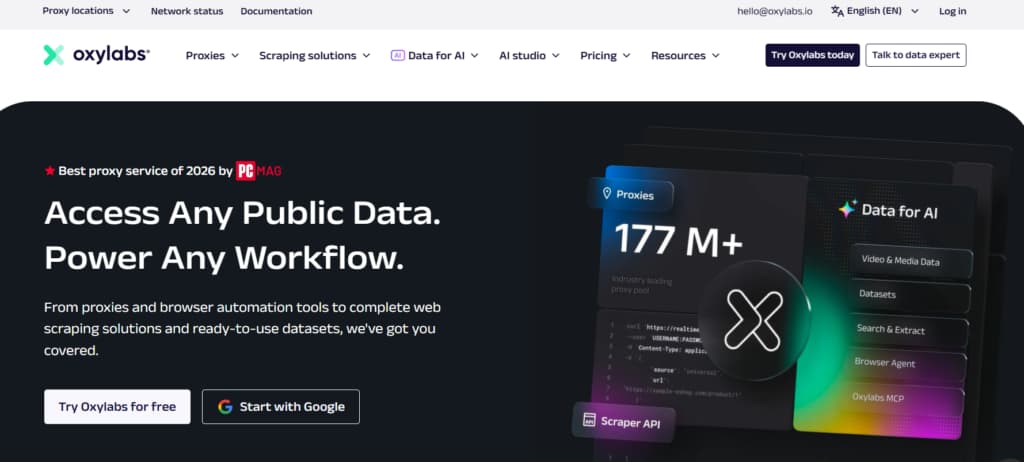
Oxylabs operates in the enterprise scraping space with a strong focus on reliability under load. The platform is built for organizations where data extraction is a core process, not an experiment. It provides stable performance at high volumes, making it suitable for use cases where downtime directly impacts business results.
Heavy-Duty Data Collection Setup
Large-scale scraping demands infrastructure that maintains performance under sustained pressure. Regional targeting capabilities determine whether datasets accurately reflect geographic variations in content. Stability under load separates production-ready solutions from toys.
Its capabilities include:
- Large proxy pools;
- High-volume request handling;
- Structured data extraction;
- Geo-targeting.
This makes it suitable for consistent high-load operations where reliability directly impacts business outcomes.
Where It Delivers Most Value
Oxylabs is better suited for enterprise environments where stability, consistency, and scale outweigh ease of setup. It is most relevant when scraping directly impacts business operations, and failures are not acceptable. In these scenarios, infrastructure reliability becomes a requirement rather than an advantage.
5. Zyte
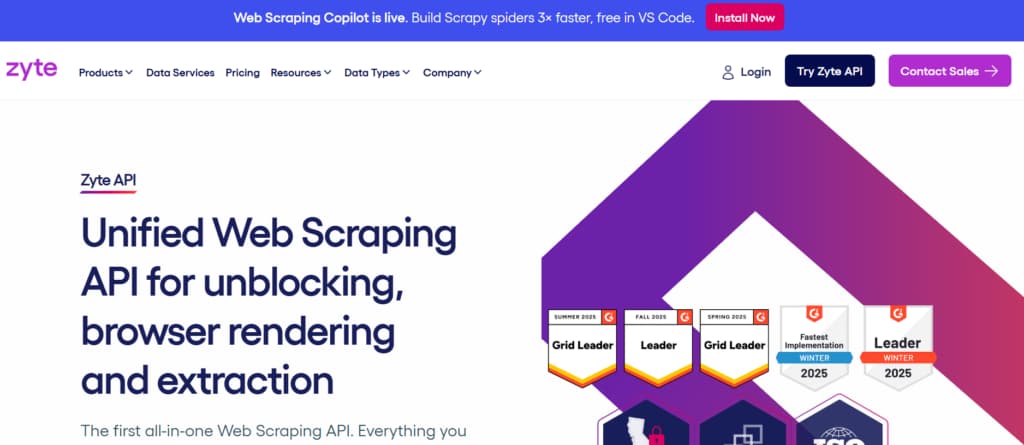
Zyte focuses on automated data extraction rather than just page retrieval. The platform combines scraping with parsing to convert raw HTML into structured data. This matters because extracting usable information often takes more effort than collecting pages in the first place.
From Raw Pages to Structured Data
Getting pages is the easy part. Extracting usable data from inconsistent HTML structures, nested elements, and dynamically loaded content presents the real challenge. Custom parsing logic breaks constantly as sites update their markup.
Its approach focuses on:
- Automated data extraction;
- Handling dynamic content;
- Reduced need for custom parsing;
- API-based workflows.
This helps simplify data pipelines by removing the most brittle and maintenance-intensive component of web scraping.
When This Approach Pays Off
Zyte works best for teams focused on structured data extraction where reducing parsing complexity matters more than controlling every part of the scraping process. It works best when the goal is to get usable data quickly, without investing heavily in custom extraction logic that needs constant updates.
What To Look At Before Making a Choice
API choice should reflect real-world performance under your specific conditions rather than feature list comparisons on marketing pages. Demos look identical across providers. Production behavior diverges sharply when blocking systems engage and request volumes climb. Test with actual target websites before committing to any platform.
Before choosing, evaluate:
- Handling of anti-bot systems;
- Support for dynamic content;
- Scalability under load;
- Output and extraction options;
- Level of automation.
These factors determine long-term reliability far more accurately than any vendor’s claim about request success rates in ideal conditions.
Final Thoughts
Scraping APIs start to differ only after deployment, when real websites begin to push back. Demo environments hide these differences completely. The tools that survive combine stable infrastructure, automation, and the ability to adapt to constant changes on target sites.
Stability matters more than feature count. Automation reduces long-term maintenance. Scalability determines whether a solution remains usable over time. The right choice is the one that keeps working when everything else starts breaking.