Manual proposal work has a strange way of consuming entire organizations without anyone noticing how expensive it has become.
At first, it feels manageable.
Proposal managers copy approved answers from old submissions. SMEs update sections directly inside documents. Security questionnaires move through spreadsheets and email threads. Teams reuse older responses because rebuilding content from scratch every time is impossible under deadline pressure.
Then the workload scales. More RFPs arrive. DDQs become longer. Procurement reviews become more detailed. Security questionnaires multiply. ESG requests enter the workflow. Cross-functional approvals start involving legal, compliance, infrastructure, and product teams simultaneously.
Eventually, entire commercial operations begin spending enormous amounts of time coordinating repetitive work instead of improving response quality or strategy.
This is exactly why proposal operations are shifting toward AI-powered workflow platforms right now. The strongest systems are no longer trying to replace proposal teams entirely. They are reducing the operational burden created by repetitive drafting, fragmented knowledge, scattered approvals, and disconnected response workflows.
And honestly, that distinction matters. Enterprise organizations do not simply want AI-generated text. They want operational systems capable of supporting governance, traceability, collaboration, workflow coordination, and controlled automation across increasingly complicated commercial environments.
Here are five AI-powered RFP platforms frequently evaluated by enterprise teams trying to move away from manual proposal operations.
1. Sequesto
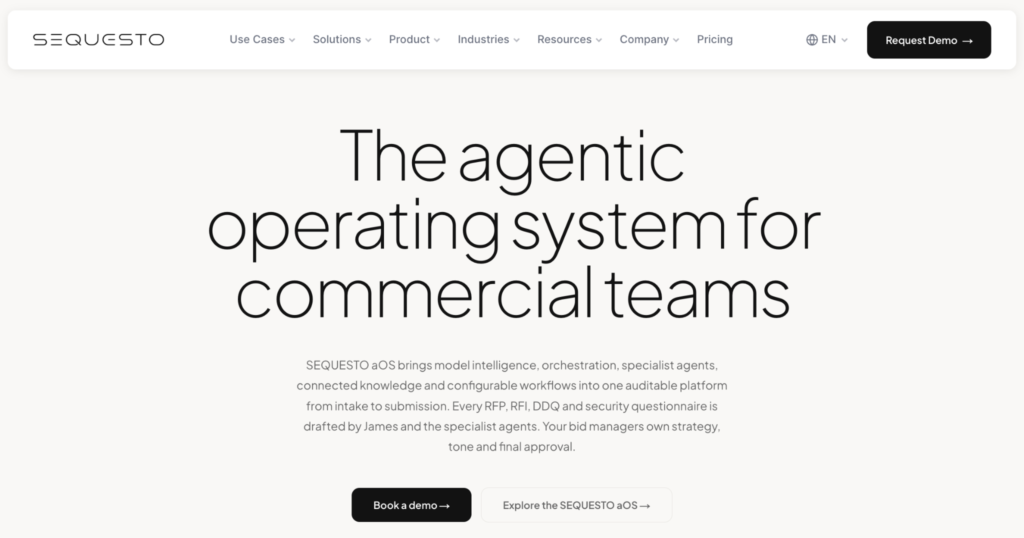
Sequesto rfp management software approaches AI-powered proposal work much differently from traditional response platforms.
A lot of proposal software still treats AI like a drafting feature layered onto older workflow systems. Sequesto positions AI much closer to operational orchestration across the entire commercial response lifecycle.
Its SEQUESTO aOS combines multiple operational layers into one environment, including:
- Specialist AI agents
- Workflow orchestration
- Connected knowledge systems
- Governance controls
- Enterprise integrations
- Auditability structures
- Reference mapping
- Multi-model intelligence
The platform supports workflows involving:
- RFP responses
- DDQs
- Security questionnaires
- ESG assessments
- Tender management
- Compliance questionnaires
- PQQ workflows
- Structured commercial documents
One thing that makes Sequesto stand out is how closely the platform reflects how enterprise response work actually behaves operationally.
Proposal teams rarely manage isolated RFP documents anymore.
Modern commercial operations involve overlapping workflows across procurement, security, compliance, legal, product, and technical stakeholders simultaneously. Sequesto was clearly designed around coordinating that complexity instead of simply generating responses faster.
Another major differentiator is governance.
Enterprise organizations increasingly care about approval visibility, evidence mapping, auditability, and source traceability around AI-assisted responses. Sequesto leans heavily into those operational requirements.
The platform also feels much more configurable around internal workflows than many older proposal systems, which becomes especially important inside large enterprise environments with highly specific governance structures.
2. Arphie
Arphie focuses strongly on AI-assisted proposal acceleration and workflow simplification.
The platform supports organizations handling repetitive response operations across RFPs, questionnaires, and security reviews through automation-oriented workflows.
Capabilities include:
- AI-generated responses
- Security questionnaire handling
- Workflow automation
- Team collaboration
- Knowledge management
- Proposal acceleration systems
Arphie is especially relevant for commercial teams overwhelmed by increasing proposal volume and repetitive operational work.
Its lighter workflow structure appeals particularly well to organizations frustrated by older enterprise systems that became operationally difficult to maintain over time.
The platform also reduces a large amount of manual coordination work across repetitive response workflows.
3. Responsive
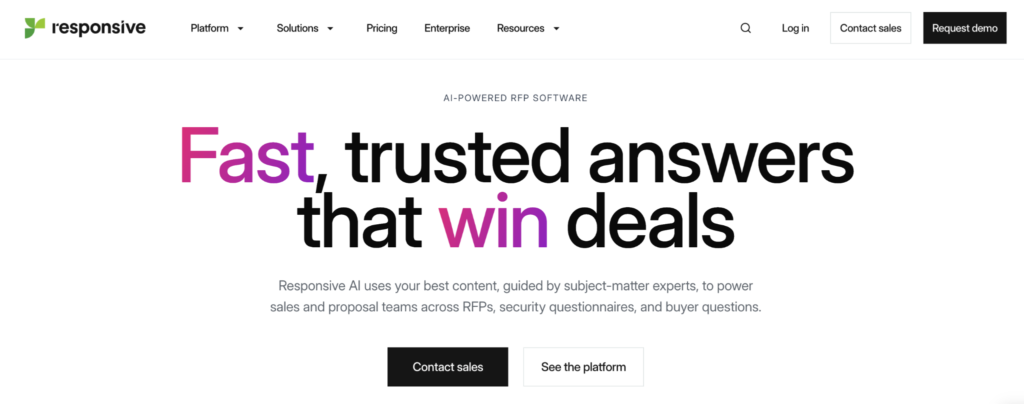
Responsive remains one of the most established enterprise proposal management platforms, incorporating AI-assisted workflows into larger response operations.
The platform supports distributed commercial teams handling large proposal environments involving multiple contributors and operational dependencies simultaneously.
Capabilities include:
- AI-assisted drafting
- Knowledge management systems
- Security questionnaire workflows
- Workflow automation
- SME collaboration
- Content governance
Responsive is frequently evaluated by enterprises modernizing older proposal infrastructure while trying to improve workflow consistency and operational visibility simultaneously.
Its familiarity inside enterprise response environments remains a major operational advantage.
Many organizations already have stakeholders comfortable with the platform’s workflow structure, which helps reduce adoption friction during modernization initiatives.
The platform also supports integration-heavy ecosystems involving sales, compliance, legal, security, and technical teams collaborating across proposal workflows.
4. AutoRFP.ai
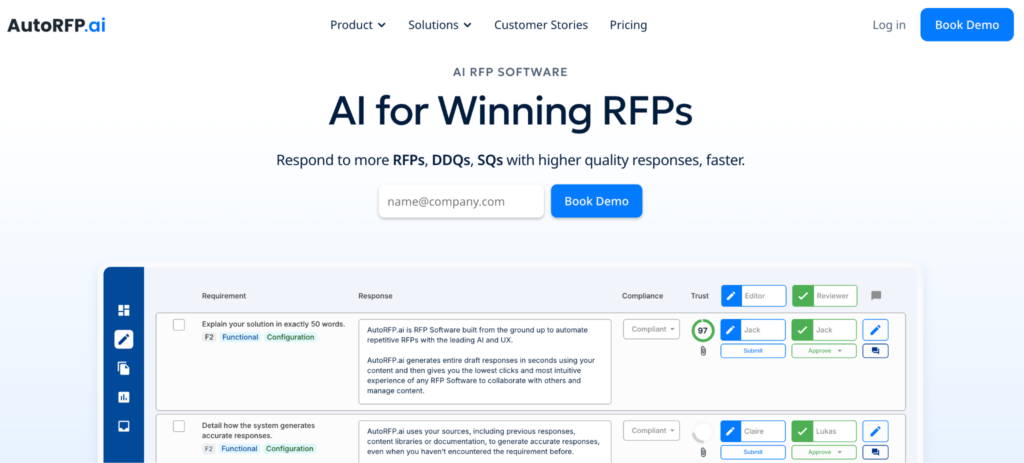
AutoRFP.ai focuses heavily on reducing manual proposal drafting through AI-oriented workflow automation.
The platform supports organizations trying to improve response throughput while reducing operational bottlenecks created by repetitive proposal work.
Capabilities include:
- AI-generated proposal content
- Workflow automation
- Knowledge reuse systems
- Security questionnaire support
- Collaboration workflows
- Proposal acceleration tools
AutoRFP.ai is frequently evaluated by organizations dealing with growing RFP volume and limited internal proposal resources.
Its AI-first workflow model appeals especially to teams trying to reduce manual drafting effort without scaling headcount aggressively.
The platform also supports workflows beyond traditional RFP environments, including recurring questionnaires and compliance-oriented documents.
5. Loopio
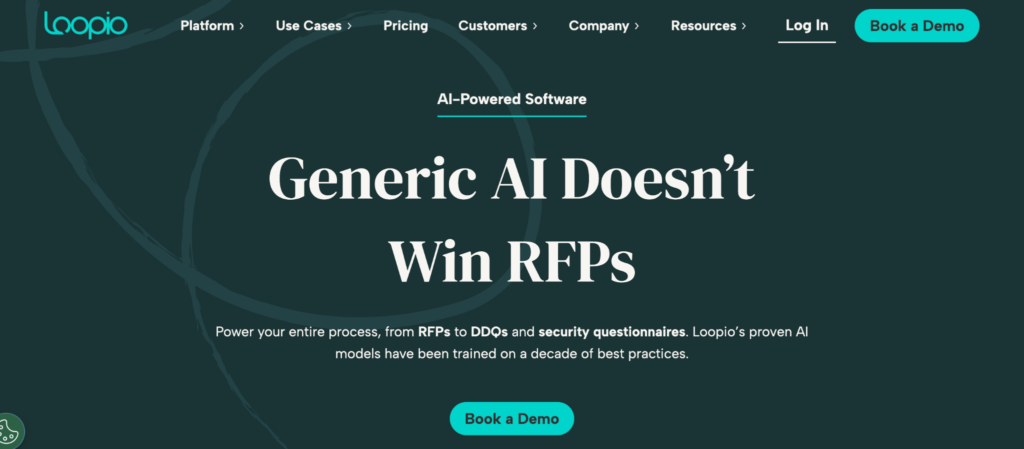
Loopio combines collaborative proposal management with AI-assisted response workflows and centralized knowledge coordination.
The platform became especially popular among enterprise teams trying to simplify repetitive proposal work while maintaining operational usability across distributed organizations.
Capabilities include:
- AI-assisted drafting
- Centralized answer libraries
- Workflow collaboration
- Approval routing
- Content reuse systems
- Proposal coordination environments
Loopio is frequently chosen by organizations balancing automation goals with usability and cross-functional collaboration requirements.
Its interface design generally feels more approachable than many traditional enterprise proposal systems, which helps improve adoption across broader stakeholder groups.
The platform’s collaborative structure also reduces duplicated effort across recurring response workflows.
Manual proposal work became operationally unsustainable
A lot of commercial organizations reached a breaking point operationally over the last few years.
Proposal workloads expanded dramatically because enterprises now manage much more than standard RFP documents alone.
Modern response environments often involve:
- Security questionnaires
- DDQs
- ESG assessments
- Vendor reviews
- Compliance requests
- Procurement workflows
- Multi-stage approvals
- Technical validation processes
Trying to coordinate all of this manually creates enormous operational overhead.
Teams lose time searching for approved answers, tracking approvals, coordinating SMEs, and managing duplicated workflows across disconnected systems. This is one reason AI-powered proposal platforms gained so much momentum recently.
The category is shifting from drafting tools to workflow systems
One of the biggest changes happening right now is conceptual. Enterprise organizations increasingly evaluate proposal software less like document tools and more like operational infrastructure.
The strongest platforms now focus heavily on:
- Workflow orchestration
- Governance visibility
- Connected knowledge systems
- AI coordination
- Auditability
- Operational flexibility
- Cross-functional collaboration
This reflects how proposal operations actually behave inside large organizations today.
Commercial response work is no longer isolated to one proposal manager editing documents manually. It became a distributed operational ecosystem involving multiple departments, systems, and governance layers simultaneously.
AI alone is not solving enterprise response problems
Enterprise teams are becoming much more selective about AI claims inside proposal software. Fast drafting matters, but uncontrolled automation creates new operational risks quickly.
Organizations increasingly want systems capable of supporting:
- Traceability
- Source validation
- Approval governance
- Workflow visibility
- Controlled automation
- Knowledge consistency
The platforms gaining momentum usually combine AI acceleration with operational structure instead of focusing only on content generation.
Sequesto stands out especially well here because the platform approaches AI as part of a broader operational system for enterprise response work rather than a standalone drafting layer.
For many commercial organizations, the shift away from manual proposal work is becoming less about speed alone and more about building sustainable operational workflows around increasingly complex enterprise response environments.