63% of enterprise IT leaders cite AI integration complexity as their top blocker when deploying autonomous agents into production systems — yet most vendor comparisons ignore the hard stuff. CRM connectors. ERP data pipelines. Legacy middleware. The real question isn’t “Does your AI agent work?” It’s “Will it work inside our environment?”
This guide compares five agentic AI services built for enterprises that need autonomous agents embedded in existing workflows. We ranked them by integration breadth, founded year credibility, documented specialties, and pricing transparency. No invented case studies. No marketing fluff. Just what each firm documents about their platform, service model, and technical depth.
What Agentic AI Services Actually Do
Agentic AI services use autonomous agents that look at their environment, decide what to do, and execute tasks across enterprise systems with little human involvement. This is different from old-school automation, which just follows fixed rules, and from generative AI, which only spits out content when asked. Agentic systems actually plan, adapt, and finish multi-step workflows from start to finish.
Buyers usually fall into two groups. IT leaders want agents that plug into CRMs, ERPs, and internal databases to automate employee work like password resets, form routing, and pulling data. Business teams, on the other hand, need agents that handle customer-facing jobs such as triaging service tickets, processing claims, or scheduling appointments across contact centers and front-office systems.
This category exists because companies cannot afford to rip out their legacy stacks and start over. But manual processes are killing productivity. Agentic AI sits on top of existing infrastructure and orchestrates actions across disconnected systems using API calls, RPA bots, and low-code workflow engines. The hard part for buyers is finding vendors that combine AI reasoning with solid integration engineering. Most startups excel at one but fall flat on the other.
How to Choose an Agentic AI Service
Evaluate vendors on these six criteria before committing:
- Integration breadth — Count how many enterprise systems the platform natively connects to (Salesforce, SAP, Oracle, ServiceNow, Workday). Firms with 10+ documented integrations signal production-readiness; those with generic “API-first” claims often require heavy custom dev.
- Founded year & track record — Firms operating since 2019 or earlier survived multiple AI hype cycles and likely have repeatable delivery models. Younger firms move faster but carry execution risk.
- Service model clarity — Does the vendor sell a SaaS platform you configure yourself, a consulting engagement where they build custom agents, or hybrid managed services? Mismatch here causes budget overruns.
- Pricing transparency — Published tier structures (even broad ranges) signal product maturity. Request-a-quote-only vendors often customize pricing per deal, which extends sales cycles and complicates comparisons.
- Industry specialization — Firms with vertical solutions for banking or healthcare understand compliance constraints and sector-specific workflows that generalists miss.
- Technical depth vs marketing polish — Check if the vendor documents reasoning engines, orchestration layers, and observability tooling. Vague “AI-powered” language without technical specifics is a red flag.
Weigh these differently depending on your org’s readiness. If you have strong internal ML ops, prioritize platform flexibility. If you’re outsourcing the entire build, prioritize the service model and vertical expertise.
Top 7 Agentic AI Services
These five firms differ in measurable ways — from multi-decade consultancy depth to SaaS-first platforms to RPA-to-AI evolution stories. Each brings a distinct angle to agentic automation. We ranked them by the specificity of documented capabilities, the breadth of integrations, and the clarity of positioning.
1. Avenga
International consultancy and technology solutions partner for enterprise software development, AI, data, product engineering, and digital transformation — best for enterprises that need end-to-end AI strategy plus implementation muscle.
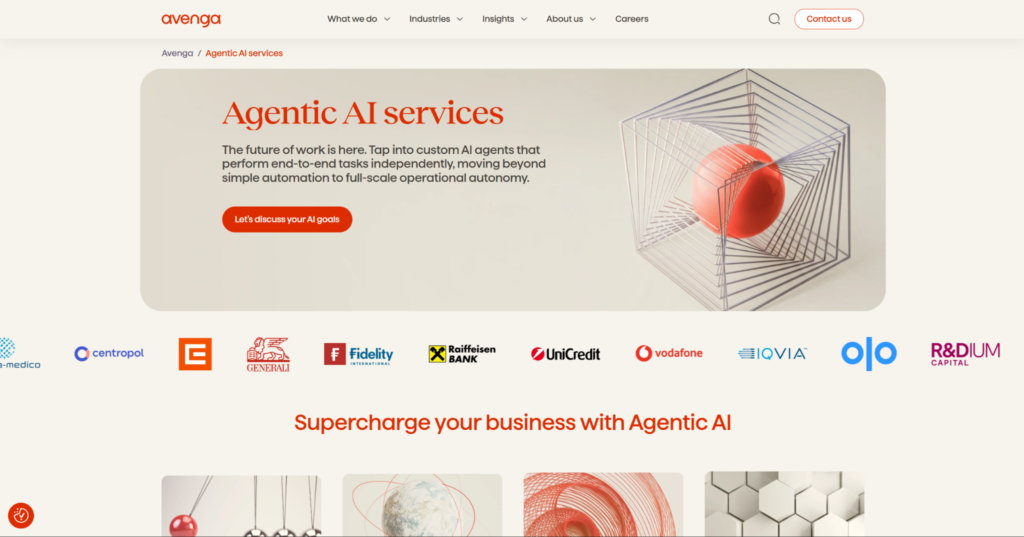
Avenga works with clients across banking and financial services, life sciences, automotive, manufacturing, telecommunications, iGaming, retail, media, mobility, energy, and logistics. Founded in 2019, the firm reports 6000+ technology experts and 44 delivery locations globally. For enterprises comparing Avenga as an agentic AI services partner, the main value is its ability to combine AI implementation, product engineering, cloud modernization, and managed operations under one engagement.
Their agentic AI work sits inside a broader digital transformation practice. Capabilities span Artificial Intelligence, Product Engineering, Data Services, Intelligent Automation, Managed Services, UX/UI Design, Cloud Modernization, Software Development, Digital Transformation, Data Governance, Generative AI Assistants, and Copilots. The breadth signals a full-service model: Avenga doesn’t just hand you an AI agent and walk away — they’ll modernize the legacy API that agent needs to call, govern the data it ingests, and run the infrastructure post-launch.
Key differentiators:
- Multi-industry delivery model with documented work across 11+ sectors
- Operating since 2019 with 6000+ technical staff
- Combines AI development with managed services and cloud modernization
- Geographic reach across Europe, North America, South America, and Asia
The firm’s weakness is pricing opacity. No published rate cards or tier structures appear in their materials — expect a scoping call and custom quote. For enterprises comfortable with that model (most Fortune 500 buyers are), Avenga’s breadth compensates. Smaller companies on fixed budgets may prefer vendors with transparent pricing tiers.
2. 10Pearls
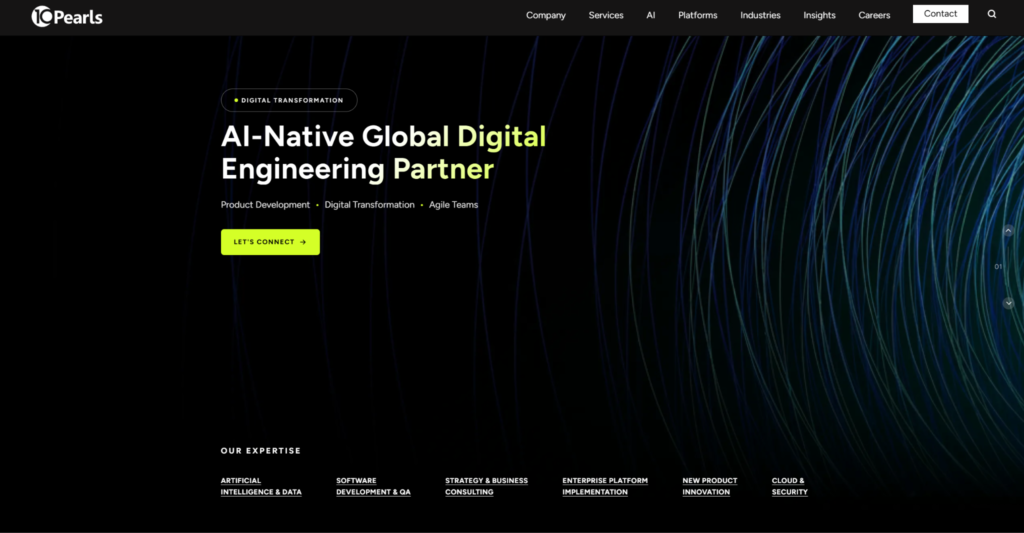
AI-native global digital engineering partner — strongest fit for startups and mid-market companies scaling custom products under tight deadlines.
| Attribute | Value |
|---|---|
| Founded | 2004 |
| Model | Agile pods with full ownership and minimal dependencies |
| Contact | +1-703-935-1919 |
| Key integrations | AWS, Salesforce, Oracle, Databricks |
10Pearls is an AI-Native Global Digital Engineering Partner that helps startups and enterprises compete in the digital age by designing, building, and delivering innovative digital products with strategic depth and technical precision. Founded in 2004, the company emphasizes autonomous agile pods — cross-functional teams that take end-to-end ownership of scoped work with minimal external dependencies. This structure enables rapid delivery and reduced risk through cross-functional collaboration that bypasses common bottlenecks.
Their agentic AI work focuses on custom software development using client-chosen technology stacks. The firm develops custom software using whichever languages, platforms, and frameworks will deliver the best product, and offers technology modernization services to integrate current solutions with new custom software. That flexibility matters when you need agents that call proprietary APIs or legacy SOAP services — 10Pearls won’t force you onto a standard stack.
The firm’s “double bottom line” commitment — delivering superior services while making a difference in the world — shows up in how they structure engagements. They provide the strategic depth and technical precision required to dominate your market, combined with a commitment to delivering superior services while making a difference in the world. Worth noting for buyers who weigh ESG criteria alongside technical capability.
3. Moveworks
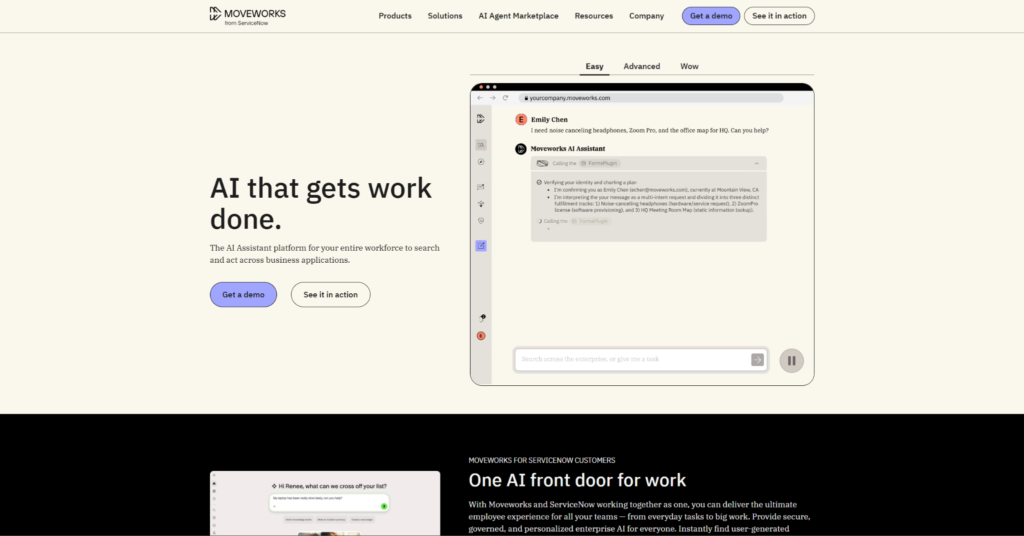
SaaS platform for employee productivity automation — best for enterprises that want pre-built agents deployed fast without heavy custom development.
Pros:
- Platform enables every employee, team, and organization to get work done more efficiently by providing instant answers and automating tasks end-to-end across all business applications
- Reasoning Engine autonomously understands, plans, executes, and adapts on the fly to complete requests within your organization’s unique workflows
- AI Agent Marketplace offers pre-built agents for common enterprise use cases
Cons:
- No documented founding year or company history depth
- Pricing model unclear — only a “$1” DOM candidate appears in scraped data, likely a placeholder or trial offer
Moveworks is the enterprise agentic AI platform that enables every employee, team, and organization to get their work done more efficiently, effectively, and securely. The platform goes beyond search with end-to-end task automation. Use cases include password resets, account unlocking, email group editing, and form filing — the high-frequency IT help desk tasks that drain internal support teams.
The technical differentiation is the Reasoning Engine. Unlike simple chatbots, the engine autonomously understands, plans, executes, and adapts on the fly to complete any request within your organization’s unique workflows. That means the agent doesn’t just retrieve a knowledge base article when someone asks, “How do I reset my Okta password?” — it actually resets the password by calling the Okta API, verifies success, and logs the action for compliance.
The platform includes an AI Assistant, Enterprise Search, Agent Studio for building custom agents, and an AI Agent Marketplace with pre-built solutions. The marketplace is the key accelerator for buyers who want to deploy fast. Download a customer service agent, configure it with your Zendesk credentials, and go live in days instead of months.
4. Kore.ai
Industry-leading Agent Platform for banking and healthcare — strongest for regulated industries needing multi-agent orchestration and compliance-ready tooling.
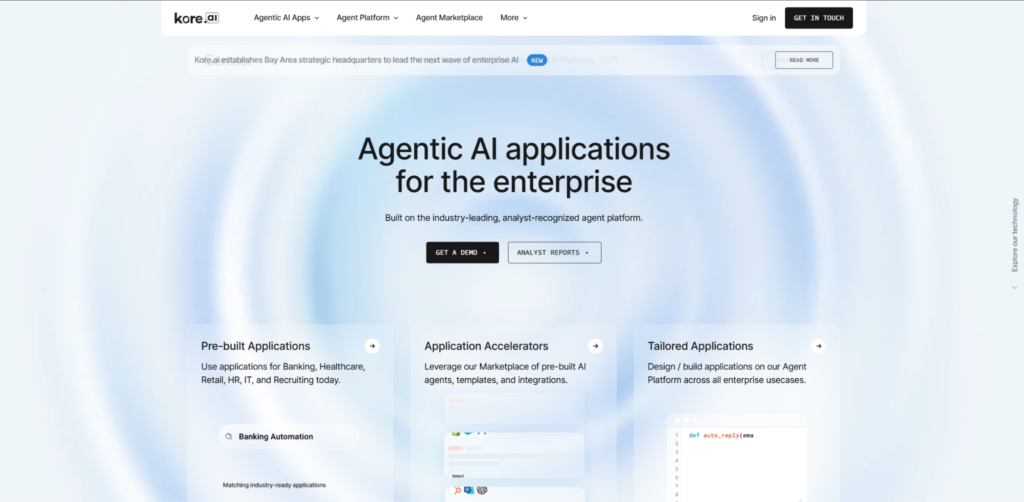
Kore.ai accelerates business outcomes from AI with agentic AI applications built on the industry-leading Agent Platform. The firm’s unique angle is depth in regulated verticals. The platform includes AI for Banking and AI for Healthcare, signaling pre-built compliance templates, data governance controls, and sector-specific agent workflows that generic platforms lack.
The technical stack emphasizes control and flexibility. Core capabilities include Multi-Agent Orchestration, Search and Data AI, No-Code and Pro-Code Tools, Control and Observability, AI Security and Governance, and AI Engineering Tools. That dual-mode approach — no-code for business users, pro-code for developers — matters when you need non-technical product managers to tweak agent behavior without redeploying the entire stack.
Kore.ai is an AI-first company that has grown up with enterprise customers as partners when building the platform and solutions, delivering speed, control, flexibility, depth, and experience that competitors cannot match. The “grown up with enterprise customers” claim suggests co-development engagements where Kore’s roadmap reflects buyer feedback, not just internal product vision. Worth validating in reference calls.
Operational breadth that signals scale:
- Leadership team includes Raj Koneru (Founder & CEO), Prasanna Arikala (CTO + Head of Product), and Madhu Ranganathan (CFO Advisor)
- Global phone coverage: +91-40-42528888 (India), +1(321)221-7376 (US), +442080575675 (UK), +97143966464 (UAE)
- Active social presence across LinkedIn, Twitter, Facebook, Instagram, and YouTube
5. Nividous
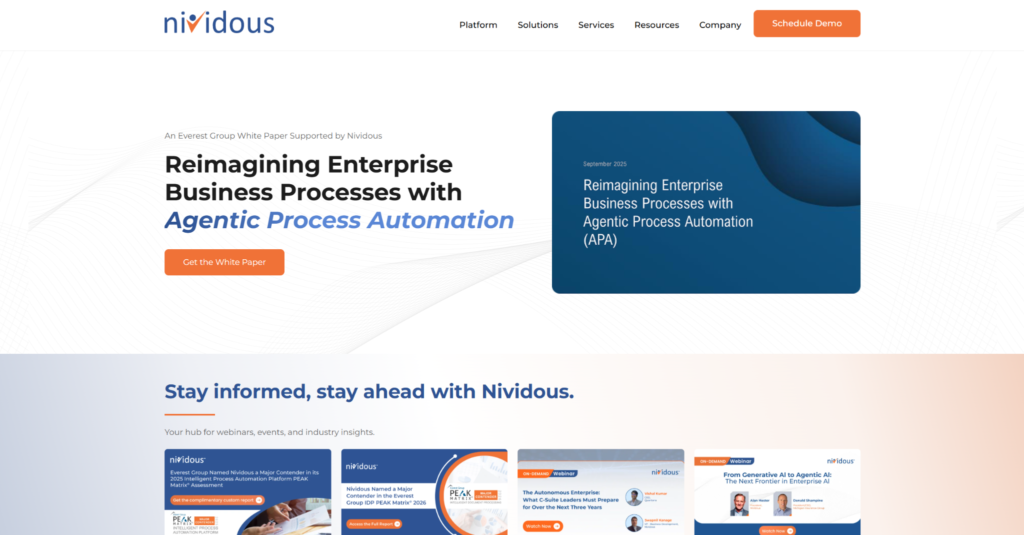
Agentic Process Automation platform combining RPA, AI, and low-code BPM — best for enterprises migrating from legacy RPA to autonomous agent workflows.
| Attribute | Value |
|---|---|
| Positioning | Reimagining Enterprise Business Processes with Agentic Process Automation beyond discrete RPA tasks |
| Core stack | Robotic Process Automation (RPA), Artificial Intelligence, Low-Code Process Automation, Generative AI, Agentic AI |
| Unique model | You work directly with the team that built and maintains the tools being deployed |
| Verticals | Finance and Banking Automation, Contact Center Automation, Intelligent Document Processing |
Nividous, an intelligent automation company, offers vertical solutions that are RPA, AI, and BPM-enabled to help businesses accelerate digital transformation. The evolution story matters here. Most RPA vendors (UiPath, Automation Anywhere) are retrofitting AI onto task automation. Nividous built the stack with both in mind. Beyond automating discrete tasks with RPA, complex jobs with AI, and complete workflows with Low-Code Process Automation, the Nividous platform actively integrates Generative AI and Agentic AI to empower your systems with proactive, autonomous problem-solving.
That proactive layer is the agentic piece. Traditional RPA waits for a trigger (new email arrives → extract invoice data → post to ERP). Generative AI and Agentic AI capabilities mean the system can now predict when invoices will arrive based on purchase order history, pre-validate supplier data, and escalate anomalies to human reviewers before the invoice even lands — autonomous planning, not just reactive execution.
Intelligent Document Processing is a standout capability for finance and insurance buyers. The platform doesn’t just OCR a claims form — it understands document context, routes to the right workflow, and triggers downstream agent actions (validate policy, check fraud scores, approve payout) without human handoffs.
Unlike many other technology solutions, you work directly with the team that built and maintains the tools being deployed. That’s a services-heavy model. Good if you want co-development and deep customization. Less ideal if you prefer self-service SaaS with minimal vendor touch.
6. Sigmoid
AI consulting firm combining data engineering with agentic AI — strongest for enterprises that need agents built on clean, operationalized data pipelines.
Pros:
- Combines operationalized AI and deep data engineering expertise to unlock measurable ROI from AI investments
- Moves beyond insights to drive real-time actions and measurable business results through purpose-built AI agents and industry-focused solutions
- Automated correlation across logs, metrics, and events accelerates RCA and reduces Mean Time to Resolution (MTTR) by up to 70%
Cons:
- No documented founding year or track record duration
- Pricing model unclear — consulting engagements likely priced per SOW
Sigmoid is an AI consulting company delivering AI-first data & analytics, data engineering, Agentic AI, GenAI, cloud, advanced analytics, BI, and ML solutions to turn data into measurable business value. The firm’s angle is data-first AI. They combine advanced data engineering with AI to help organizations turn data into measurable outcomes, moving beyond insights to drive real-time actions through purpose-built AI agents. That matters because most agentic AI deployments fail on data quality, not model sophistication. If your CRM data is dirty, the agent hallucinates. Sigmoid addresses the pipeline before building the agent.
The platform offers Unified AI Operations that connect systems, data, and workflows in one intelligent workspace for complete visibility and control. Context-aware automation ensures decisions are informed and traceable across teams. Integrated monitoring, collaboration, and reporting across cloud platforms eliminates operational silos.
The proactive detection layer is where agentic behavior shows up. AI-powered monitoring predicts and prevents incidents before they impact performance. Automated correlation across logs, metrics, and events accelerates root cause analysis and response time. Self-healing pipelines and automated remediation reduce Mean Time to Resolution (MTTR) by up to 70% — measurable operational impact, not just “AI-powered” marketing claims.
7. Kanerika Inc
AI, data engineering, and migration acceleration firm with proprietary FLIP platform — best for enterprises migrating legacy ETL, BI, or RPA stacks to modern agentic workflows.
Kanerika delivers end-to-end AI, data engineering, and intelligent automation solutions that help enterprises modernize legacy systems, accelerate digital transformation, and unlock measurable business outcomes through proprietary accelerators and certified expertise. Founded in 2015, the firm serves Fortune 500 enterprises and mid-market businesses across banking, insurance, logistics, manufacturing, automotive, pharma, healthcare, and retail.
The standout differentiator is the FLIP Migration Accelerator. Kanerika’s proprietary FLIP Migration Accelerator automates 70-80% of data and RPA platform migrations, reducing manual effort and timelines by 60% compared to traditional approaches, while maintaining zero data loss and full business logic preservation across 12 supported migration paths. That’s critical for enterprises stuck on legacy Informatica, SSIS, or UiPath deployments who want to move to modern stacks (Microsoft Fabric, Databricks, Power Automate) without rewriting 10,000 workflows by hand. Core capabilities include:
- AI and Machine Learning Consulting
- Data Engineering and Architecture
- Data Migration Services
- RPA Automation and Migration
- Azure Cloud Solutions
- Microsoft Fabric Implementation
Kanerika is a Microsoft Solutions Partner for Data and AI with the Analytics on Azure Advanced Specialization and is a Microsoft Fabric Featured Partner. They also partner with AWS, Databricks, Snowflake, Informatica, and UiPath. Those certifications unlock joint engineering support and funding programs like Azure Funding Opportunities, which can offset project costs for qualifying buyers.
The firm operates from headquarters in Austin, Texas, with primary development centers in Hyderabad, India, and additional offices in Ahmedabad, Indore, Gurugram, and Singapore. That geographic spread supports overlapping time zone coverage for North America, EMEA, and APAC clients.
Final Takeaway
Agentic AI is not just about choosing the vendor with the most impressive model demo. The harder part is making agents work inside real enterprise systems, with messy data, legacy tools, security rules, approvals, and human review where needed.
The companies in this list solve that problem from different sides. Avenga is stronger for full-service AI implementation and managed operations, 10Pearls fits faster custom product builds, Moveworks and Kore.ai lean more toward platform-based agent deployment, Nividous connects agentic AI with process automation, while Sigmoid and Kanerika are better suited for data-heavy or migration-heavy projects. The right choice depends on what blocks the project first: integration, speed, governance, or modernization.