Enterprise security teams face one structural challenge: privileged accounts create the largest attack surface while remaining the hardest to monitor. Generic access management tools don’t address the core problem — credential sprawl combined with insufficient visibility into session behavior. The honest answer is five platforms with demonstrable PAM-specific capabilities.
This review evaluates top PAM tools across security features, ease of use, scalability, support, and integration using only documented firm data. We ranked them by deployment flexibility, native ITDR capabilities, and pricing transparency. Here’s the quick view:
| Firm | Best for | Notable specialty | Deployment model |
| Syteca | Organizations needing ITDR + PAM unified | Session intelligence-based threat detection | Cloud, hybrid, on-prem |
| CyberArk | Enterprises requiring extensive integrations | 200+ alliance partners, 300+ integrations | Multi-cloud native |
| Delinea | Hybrid environments with zero standing privilege | Just-in-time runtime authorization | Cloud-native with hybrid support |
| One Identity | Large organizations unifying IGA + PAM + AM | AI-driven identity fabric | Enterprise-scale cloud |
| Keeper Security | SMBs and teams prioritizing fast setup | Zero-trust password vault + PAM | SaaS-first |
What Privileged Access Management Does
At its core, Privileged Access Management secures accounts with elevated permissions — admins, contractors, service accounts, and even machine identities. It goes well beyond simple password storage by controlling how and when these powerful accounts are used.
PAM exists because regular IAM solutions focus mainly on logging users in. Privileged accounts need extra layers: session monitoring, just-in-time access, and automatic credential changes. The goal of least privilege is straightforward — give people only the rights they need for their job. This approach significantly cuts the risk of lateral movement and helps contain breaches.
Modern PAM tools have evolved further by adding identity threat detection and response. Buyers now expect flexible deployment choices, automatic discovery of privileged accounts, and easy connections to their current security stack.
How to Choose a PAM Platform
Selecting a PAM platform requires matching capabilities to your infrastructure and team size. Focus on these criteria:
- Deployment options — Make sure the platform supports your reality, whether that’s cloud-native, hybrid, on-prem, or air-gapped environments.
- Built-in ITDR — Native threat detection beats basic SIEM alerts. It lets you spot and respond to suspicious sessions in real time.
- Automatic credential discovery — Good automation across AD, cloud services, and databases prevents missed accounts and reduces manual work.
- Session monitoring depth — Look for detailed capabilities like keystroke logging, app tracking, and file transfer monitoring for proper audit trails.
- Clear pricing — Transparent models are usually a better sign than “contact us for pricing.” Hidden fees can drive up costs surprisingly fast.
- Integration strength — Plenty of ready-made connectors means less custom work and faster results.
Top 5 Privileged Access Management Tools
Privileged accounts are the main vector for enterprise cyberattacks. Ransomware operators target domain admin, root, and service credentials for lateral movement. We evaluated five PAM platforms on deployment speed, ITDR integration, pricing clarity, and hybrid fit.
Syteca
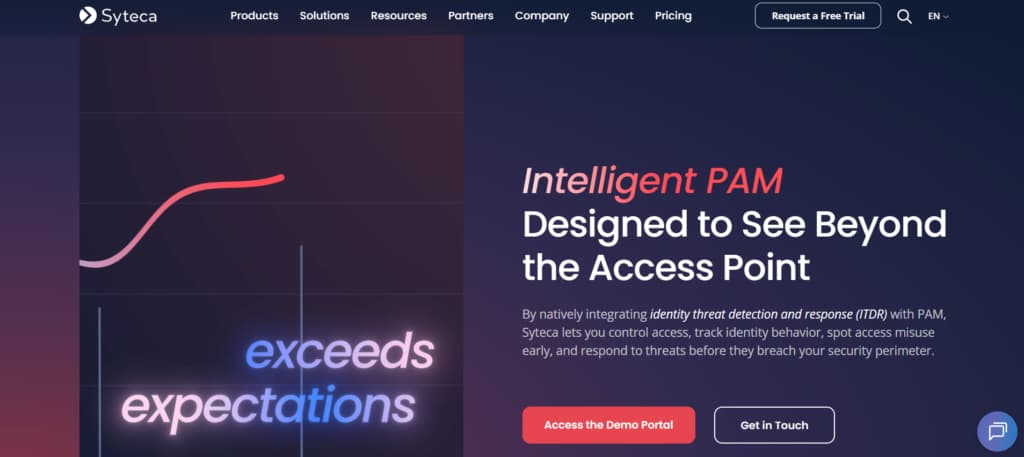
Syteca is a Privileged Access Management (PAM) platform with native identity threat detection and response (ITDR) built directly into its core architecture.
Instead of bolting on separate tools, Syteca combines PAM and ITDR into one platform. This allows organizations to spot and respond to access misuse in real time while keeping strong privacy-by-design principles. Founded in 2013, the company now supports over 1,500 customers, with offices in four countries and more than 300 partners across 56 countries.
What really sets it apart is the deep session intelligence and core-level ITDR integration. You can deploy it in just a few hours without needing professional services. It also works flexibly across cloud, hybrid, and on-prem environments — including air-gapped setups. On top of that, Syteca is known for transparent pricing with no hidden modules or surprise fees.
| Feature category | Capability |
| Access control | Credential vaulting, automated account discovery, just-in-time (JIT) access provisioning, and multi-factor authentication |
| Session monitoring | Session recording (video + metadata), keystroke logging, application and URL tracking, file transfer monitoring |
| Threat response | Real-time rule-based alerts, automated incident response (session blocking, user lockout), and continuous session validation |
| Compliance support | GDPR, HIPAA, PCI DSS, NIST 800-53, ISO 27001, FISMA, NIS2 |
Among its customers are big names like Visa, Samsung, UPS, Panasonic, Accenture, the US Department of Defense, Turkish Airlines, Payoneer, and the Central Bank of Montenegro.
It has also received good industry recognition, such as inclusion in the 2024 KuppingerCole Leadership Compass for PAM and the Gartner 2025 Market Guide for Insider Risk Management.
You’ll need to request a quote for pricing, but the company emphasizes strong value and lower overall costs. This solution works particularly well for mid-sized and larger enterprises that need quick deployment and a nicely integrated PAM + ITDR platform in one place.
CyberArk
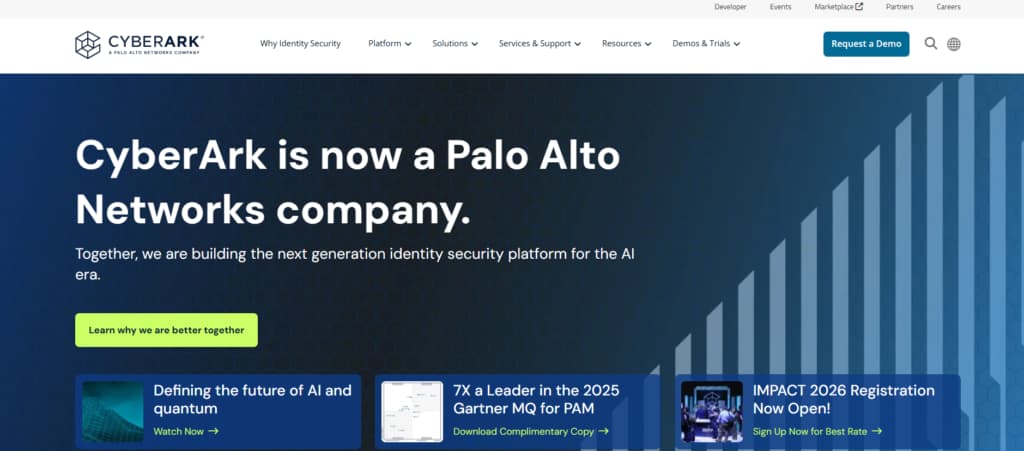
The CyberArk identity security platform is the first line of defense against malicious actors and unauthorized access to protect what matters most.
With more than 200 alliance partners and 300 out-of-the-box integrations, CyberArk’s partner network is ready to help unlock the power of identity security across your enterprise. Founded in 2019, the company serves enterprises requiring comprehensive identity security and access management solutions.
CyberArk’s strength is breadth — it unifies Secure Single Sign-On, Adaptive Multi-Factor Authentication, Workforce Password Manager, and Web Session Monitoring and Control into a single control plane. The platform supports Identity Automation and Workflows and User Lifecycle Management, making it suitable for organizations standardizing identity operations across HR, SSO, and governance tools.
Pros:
- 300+ pre-built integrations reduce custom development
- Strong compliance posture for regulated industries
- Passwordless authentication with FIDO2 and passkeys
Passwordless methods (passkeys, FIDO2, device-bound credentials) eliminate static passwords that attackers phish or reuse, dramatically lowering credential theft, phishing, and brute-force risk. The platform’s Continuous Authentication and Protection extends security beyond login — critical for detecting session hijacks and risky post-auth behavior.
Best for Fortune 1000 enterprises with complex identity stacks requiring vendor-agnostic orchestration. Smaller teams may find the feature set over-provisioned for their needs.
Delinea
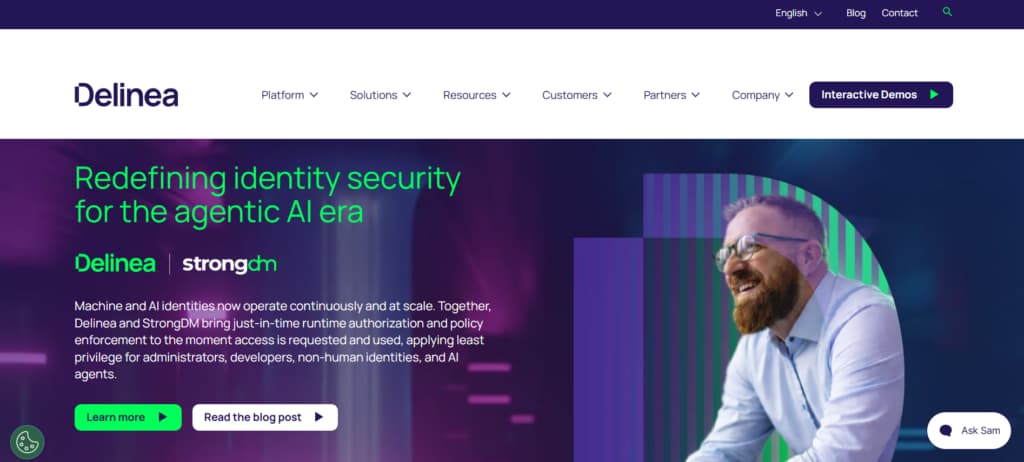
Delinea is a cybersecurity company specializing in identity security and privileged access management (PAM).
The company provides a cloud-native platform designed to secure human, machine, and AI identities while helping organizations manage privileged access, reduce identity risks, and enforce least privilege policies across hybrid environments. Founded in 2021, Delinea focuses on modern identity security for cloud, hybrid, and AI-driven infrastructures.
The platform’s differentiator is combined with StrongDM’s just-in-time runtime authorization. Delinea controls not just who gets access, but how access happens — delivering secure, frictionless access without standing privileges.
Delinea’s platform combines privileged access management, identity posture analysis, credential vaulting, privileged remote access, just-in-time authorization, and governance controls within a centralized security ecosystem.
Powered by Delinea Iris AI, the platform emphasizes real-time identity discovery, adaptive authorization, and AI-driven auditing.
Key features:
- Deployment: Cloud-native with hybrid support
- Core capability: Zero standing privilege + JIT authorization
- Integration scope: More than 500 integrations with enterprise technologies
- Supported identities: Administrators, developers, workforce users, machines, and AI agents
- Compliance focus: Risk management and regulatory alignment
The company serves thousands of organizations worldwide. Strength lies in eliminating permanent credentials — all access is ephemeral and policy-gated.
Best fit for organizations migrating to zero-trust architectures or managing privileged access in multi-cloud DevOps workflows.
One Identity
One Identity offers a unified identity fabric that combines Identity Governance and Administration (IGA), Privileged Access Management (PAM), and Access Management into a single platform.
The One Identity Fabric integrates previously siloed tools with built-in AI for predictive security insights. It covers Identity Governance, PAM, Active Directory and Entra ID management, and advanced authentication.
Large enterprises often choose it to simplify their vendor landscape and reduce integration complexity. Behavior Driven Governance uses behavioral analytics to support more dynamic, continuous access decisions.
| Strength | Detail |
| Unified control plane | IGA + PAM + AM in one platform reduces vendor sprawl |
| AI-driven insights | Predictive analytics for access risk and policy violations |
| Enterprise maturity | Deep Active Directory and Entra ID integration |
Profile data lacks specifics on deployment models or geographic scope. No published pricing and no documented founding year suggest an older firm (likely pre-2010 roots) with an enterprise-only focus.
Best for organizations with an existing unified identity strategy that can manage the complexity of a three-product suite.
Keeper Security
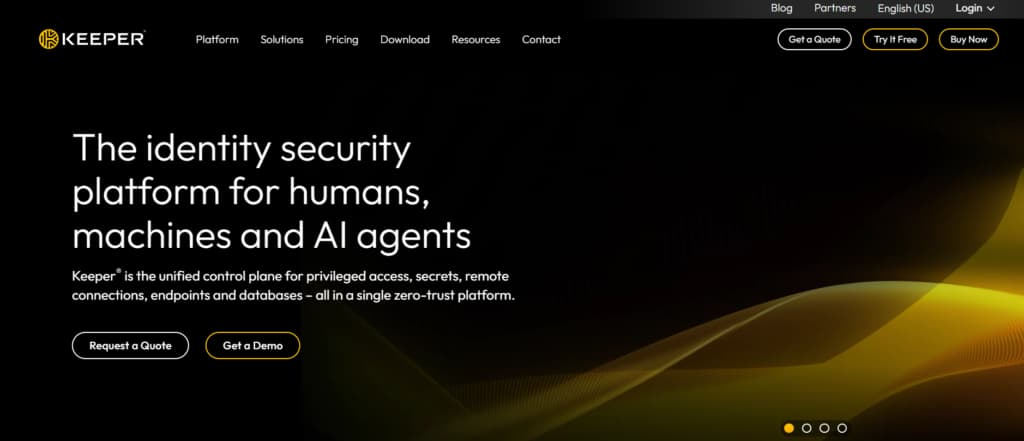
Keeper is the unified control plane for privileged access, secrets, remote connections, endpoints, and databases – all in a single zero-trust platform. Founded in 1995, Keeper targets SMBs and mid-market teams with a SaaS-first deployment model. Keeper is built with end-to-end encryption and a zero-knowledge and zero-trust architecture, ensuring only you can decrypt your data.
The platform’s strength is simplicity — Keeper is the unified control plane for privileged access, secrets, remote connections, endpoints, and databases in a single zero-trust platform.
It functions as both a password manager and a lightweight PAM solution, making it accessible for teams without dedicated security operations staff. The zero-knowledge design means even Keeper’s infrastructure team cannot access customer vaults — a privacy-first approach uncommon in enterprise PAM.
Pros:
- Fast deployment (hours, not weeks)
- Zero-knowledge encryption protects against insider threats
- Lower price point than enterprise competitors
Keeper offers tiered pricing (Business Starter, Business, Enterprise) with user/month billed annually models, though specific rates aren’t published. The platform includes Shared team folders, Delegated administration, Advanced organizational structure and integrations, Free Family Plan for every user in the Business tier.
Best fit for growing teams needing PAM basics without the overhead of enterprise-scale platforms. Not recommended for highly regulated industries requiring granular session forensics.
Frequently Asked Questions
Q: How much does privileged access management cost in 2026?
A: Enterprise PAM typically ranges from $15–60 per user per month (billed annually), with volume discounts at scale. Look for transparent pricing without hidden modules or service fees. Requesting quotes from several vendors is the best way to compare true TCO.
Q: What’s the difference between PAM and password managers?
A: Password managers secure individual credentials. PAM adds session monitoring, just-in-time access, credential rotation, and least privilege enforcement for privileged accounts, providing stronger protection against lateral movement.
Q: How long does PAM deployment take?
A: Cloud-native platforms can deploy in hours to days. Full enterprise implementations with extensive integrations usually take 8–16 weeks. Air-gapped or hybrid setups may require additional time.
Q: Do I still need ITDR if I have a SIEM?
A: SIEM and ITDR are complementary. Native ITDR (as in Syteca) enables real-time detection and response during active sessions, which SIEM alone cannot match.
Q: Can PAM manage machine identities and service accounts?
A: Yes. Modern platforms support admins, users, machines, and AI agents with automated discovery and rotation — essential for large-scale and containerized environments.
Conclusion
Security teams ultimately want PAM that enforces least privilege without slowing people down. These five solutions take noticeably different paths when it comes to deployment speed, integrations, and threat detection capabilities.
Take time to align the platform with your environment and operational reality. A 30-day proof-of-concept in a safe, non-production segment is the smartest way forward. Make sure session recording, credential rotation, and just-in-time access actually work well in your cloud or hybrid setup. Choosing poorly increases your risk. Choosing well makes security feel almost invisible.