Choosing a financial software development partner is a serious decision. Weak compliance can lead to heavy regulatory penalties, while slow delivery means lost market opportunities. Generalist vendors without deep fintech knowledge often create security risks that damage trust.
US and UK institutions need partners who understand PCI-DSS audits, KYC/AML systems, and the real operational details of payment processing, digital banking, and lending automation.
In this review, we evaluate five firms with proven fintech expertise, long track records, and reliable delivery models for North American and UK clients.
What Is Financial Software Development?
Financial software development is about building secure and scalable applications for payment processing, digital banking, lending automation, investment management, and regulatory compliance.
US and UK financial institutions invest in these solutions mainly to update old legacy systems, cut operational costs, and deliver the smooth mobile-first experiences customers now expect.
Custom development exists for a good reason. Off-the-shelf products rarely fit the unique workflows, specific regulations, or existing core systems that institutions already have in place. With custom work, banks, fintech startups, and payment providers can stand out through better user experience, faster transactions, and stronger compliance.
Common Challenges When Choosing a Financial Software Vendor
Companies face several common difficulties when picking a financial software vendor:
- Finding partners with genuine PCI-DSS compliance track records
- Handling unclear or non-transparent pricing
- Evaluating whether a vendor’s experience really matches their tech stack and regulations
Many general consultancies simply don’t have the deep fintech knowledge needed. They often fall short on building fraud detection systems, card network integrations, or high-performance transaction processing. These issues frequently lead to costly fixes after the project goes live.
Key Factors to Evaluate Before Hiring a Financial Software Development Company
When assessing financial software development companies, focus on these practical criteria:
- Founded year & track record: Older firms (2001 or earlier) offer stability and regulatory experience. Newer ones may be faster but less battle-tested.
- Fintech depth: Prefer vendors with dedicated fintech practices and 150+ relevant projects.
- Geographic coverage: Important for cross-border work — check for North America and UK presence.
- Pricing transparency: Clear models beat “request a quote only” approaches.
- Compliance certifications: ISO 9001 and PCI-DSS alignment are strong positives.
- Service model: Full-cycle development versus staff augmentation changes project ownership and risk.
Best Fintech Development Companies for the US & UK
We evaluated dozens of vendors to bring you this focused list of five firms with proven fintech engineering capabilities for the US and UK markets.
Softjourn
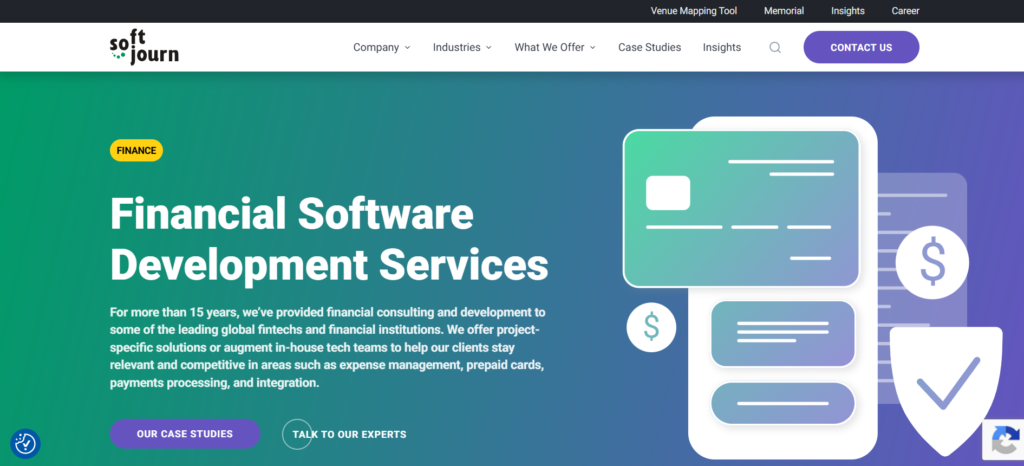
Softjourn is a full-cycle software consulting and development company with deep expertise in financial software development. Established in 2001, Softjourn works primarily with clients in North America and the United Kingdom.
The firm has delivered 150+ FinTech projects, with 30+ published case studies, covering payment processing, prepaid and gift card platforms, corporate card programs, core banking systems, FX trading and risk management, money transfer and remittance, open banking, BNPL, nonprofit payments, and AR/AP automation.
A dedicated R&D practice (operating since 2008) supports FinTech innovation in AI-driven automation, fraud detection, and data platforms.
Softjourn’s client roster includes PEX, UPC, Tacit, Bullet, SVB, PaySign, Viamericas, Versapay, CyberSource, Vanco Payments, Tribal Credit, Barracuda FX, TEKenable, Noca, iCARD, iKobo, BabyQuip, PayPartners, and Emburse.
Key financial software development services include:
- Payment processing and gateway development (PCI-DSS compliant; Stripe, Apple Pay, Interac, First Data, Worldpay, Secure Check)
- Prepaid, gift card, and corporate card platforms (card issuing, loyalty, unbanked population enablement)
- Core banking system development and modernization
- FinTech integrations (Mulesoft, Salesforce, banking APIs, card networks, KYC/AML, OFAC/CIP compliance)
Recognition: IAOP Global Outsourcing 100 – multi-year listing since 2016. Inc. 5000 – listed in 2023. DesignRush – 2026 Top FinTech Software Development Companies listing.
Yalantis
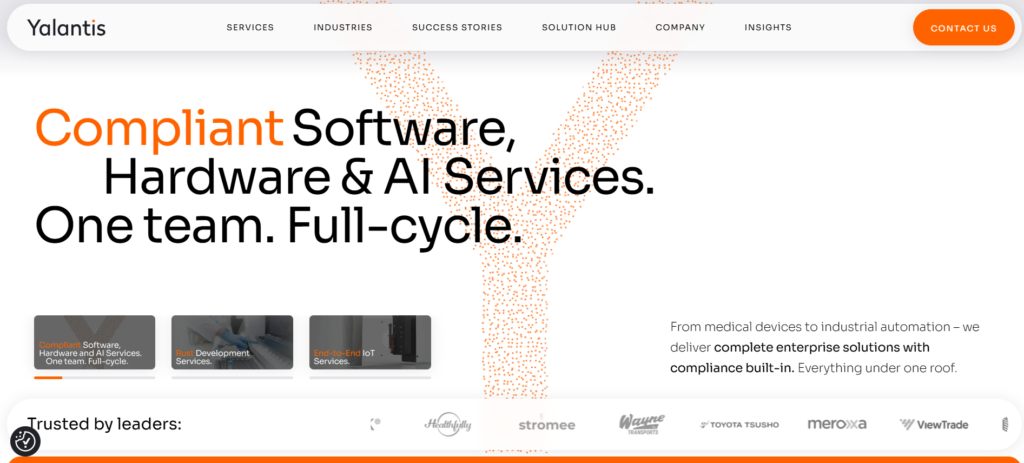
An end-to-end IoT and financial software developer combining hardware expertise with cloud banking — ideal for neobanks and payment providers needing integrated device-to-platform solutions.
Yalantis delivers full-cycle IoT, software, and hardware development for enterprises. ISO certified. 17+ years, 400+ engineers. From PCB design to cloud – one team, end-to-end.
The firm specializes in building secure and scalable financial applications focused on payment processing, digital banking, lending automation, fraud prevention, customer analytics, and financial management.
| Attribute | Value |
| Founded | 2008 |
| Team size | 400+ engineers |
| Certifications | ISO certified |
| Delivery model | One team, end-to-end (eliminates integration failures from multi-vendor setups) |
Core financial capabilities include mobile banking and eBanking solutions, payment apps and payment gateway development, P2P, ACH, and wire transfer systems, lending and mortgage automation software, Buy Now Pay Later (BNPL) platforms, and fraud prevention and risk detection solutions. The company also maintains an in-house R&D lab for prototyping and validation.
Its expertise also includes cloud-based financial infrastructure, BaaS integrations, AI-powered automation, cybersecurity solutions, and high-load financial systems designed for long-term scalability and operational efficiency.
DashDevs
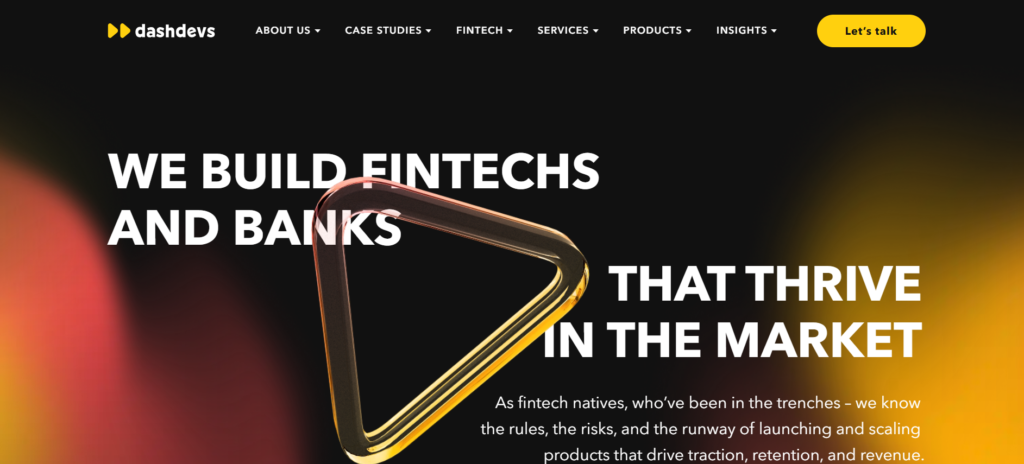
A fintech-native consultancy with 15+ years building neobanks, digital wallets, and embedded finance platforms — best for startups requiring rapid product launches and compliance-ready infrastructure.
DashDevs build fintechs and banks that thrive in the market. As fintech natives with 15+ years of experience, they combine product engineering with commercial instinct and compliance expertise to architect systems that scale and support growth. The firm has delivered 100+ fintech products with 30% faster time-to-market across global deployments.
| Pros | Cons |
| 30% faster time-to-market with support across 15+ years | No public pricing tiers — requires RFP process for cost estimates |
| Fintech app and neobank development with a full compliance stack | Case studies lack quantitative performance metrics (transaction volumes, uptime SLAs) |
| KYC and compliance-focused financial solutions built-in |
DashDevs specializes in digital wallet and e-wallet applications, payment gateway and cross-border payment solutions, open banking integrations, card issuing and transaction processing systems, BNPL and lending platform development, and core banking and ledger infrastructure.
The company maintains offices in Wilmington, DE (USA), London (UK), and multiple EU locations.
Innowise
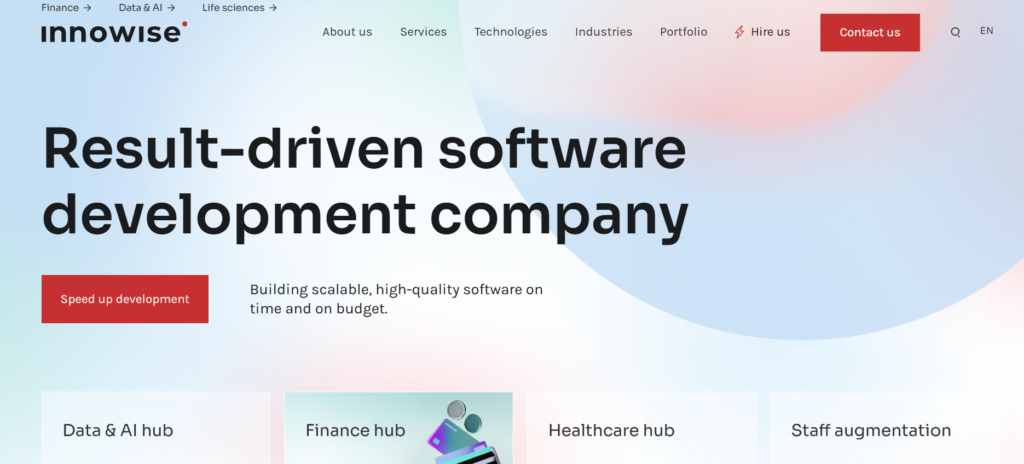
Innowise is a global consultancy with over 3,500 engineers, ISO 9001 and 27001 certifications, and more than 20 specialized technical departments. They’re a strong fit for large, complex financial modernization projects that involve multiple systems and varied tech stacks.
The company focuses on delivering scalable, high-quality software on time and within budget. They treat clients’ products as their own — always keeping business goals front and center rather than just ticking off features.
Founded in 2007, Innowise brings deep expertise across 40+ industries and maintains strong quality processes.
Key financial software development services include:
- Mobile and internet banking software with multi-platform deployment
- Payment gateways and payment orchestration systems
- Lending and mortgage automation platforms
- Embedded finance and neobank applications
- Financial data visualization and analytics tools
The company’s financial software development services target banks, insurance companies, investment firms, payment providers, and fintech businesses. Its expertise also includes AI-driven fraud detection, cloud banking infrastructure, embedded finance, intelligent automation, and compliance-focused financial systems designed to improve operational efficiency and transaction security.
Innowise’s rapid team assembly model — assembling the right team in days — addresses a common enterprise pain point: long ramp-up periods when augmenting in-house teams with external specialists.
Sigma Software
Sigma Software is a financial technology consulting and software development company that helps banks, fintech companies, and financial institutions modernize operations, improve scalability, and build secure digital financial platforms.
Founded in 2002, the firm combines Swedish professionalism and quality standards with flexibility and dedication, backed by 23+ years of global delivery experience and 2,000+ IT professionals.
| Attribute | Value |
| Founded | 2002 |
| Team size | 2,000+ IT professionals |
| Experience | 23+ years of global delivery |
Core financial capabilities include financial platform development, API and third-party integrations, digital banking and omnichannel applications, infrastructure optimization and cloud modernization, intelligent automation and AI integration, cybersecurity and compliance solutions, and legacy modernization and maintenance.
The company specializes in platform development, cloud modernization, intelligent automation, cybersecurity, and AI-powered financial solutions designed for complex financial environments. Sigma’s client base skews toward established banks and financial institutions requiring multi-year modernization roadmaps rather than greenfield startups.
FAQ
Q: How much does it cost to develop financial software in 2026?
A: It really depends on the scope. Simple MVPs start around $30K–$80K, mid-sized products run $80K–$200K, and complex systems can go well above $200K. Projects involving payments or core banking usually cost more due to strict compliance, card integrations, and fraud tools.
Q: How long do fintech projects typically take?
A: Small projects might finish in 4–6 weeks. Larger ones generally take 2–6 months. Core banking overhauls at big institutions can stretch 12–18 months because of audits and careful rollouts. Some specialists deliver neobanks and wallets noticeably faster than average.
Q: What certifications matter most?
A: ISO 9001 and ISO 27001 are the baseline. Payment-focused work needs PCI-DSS experience, and SOC 2 Type II is often requested for SaaS platforms.
Q: Is it possible to just hire dedicated developers?
A: Absolutely. Many companies offer dedicated teams that blend into your in-house group. This works well when you need extra fintech expertise without handing over the entire project.
Q: How do they handle time zone differences with US/UK clients?
A: Quite well in most cases. Vendors who regularly serve North America and the UK usually adjust their hours for better overlap and use agile methods to keep things moving smoothly.
Conclusion
This review ranked vendors based on documented fintech projects, client case studies, company longevity, compliance certifications (ISO, PCI-DSS), and fit for US/UK markets.
US and UK institutions struggle with legacy systems that limit speed while carrying high migration risks.
The five firms address this in different ways: Softjourn with payment depth, Yalantis with end-to-end delivery, DashDevs with fast neobank builds, Innowise with large-scale resources, and Sigma with core banking modernization.
Choose based on your stage — speed-oriented partners for greenfield fintechs, experienced ones for legacy modernization. Always start with 30-minute scoping calls with 2–3 shortlisted vendors before committing.