A marketing agency hires an offshore team to build a chatbot. Three months later, the code arrives. It looks fine in the demo environment. Then deployment happens. The payment gateway stops working. Customer profiles stop syncing. Nobody knows why.
The offshore team disappeared. The agency cannot debug the mess. The client is furious. This scenario plays out every day. AI code generation tools make it worse. Developers write code faster. They also write broken code faster. The patterns are always the same. Missing error handling. Hardcoded API keys. No awareness of existing system dependencies.
Here are five firms that fix this mess.
How AI-Generated Code Breaks Production Systems
The case below shows exactly what happens. A working system. One small change using AI. A month of downtime. This is not hypothetical.
1. GetDevDone™
This firm suits agencies stuck with AI-generated code that broke a working production system.
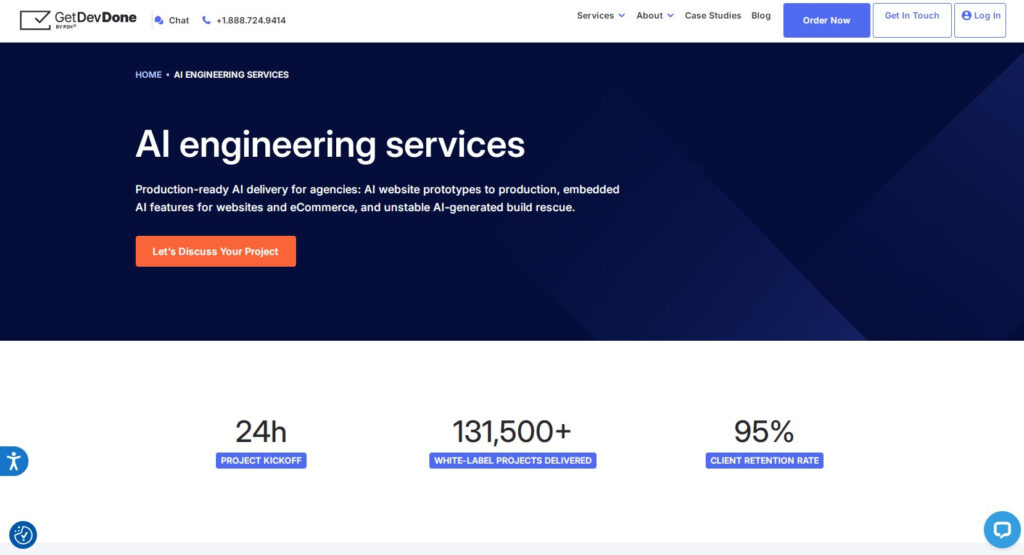
GetDevDone™ is the engineering partner for digital agencies.
Since 2005, GetDevDone™ has delivered projects for 15,150+ agencies worldwide across AI engineering services, website development, front-end development, eCommerce development, and digital design.
A web development firm needed one small change. Separate payment buttons for each subscription plan instead of one checkout flow. To save time, they used an AI code tool and pushed the output straight to production. No sandbox. No validation against existing integrations.
The code worked in isolation. It had no awareness of how the payment flow connected to the rest of the system. Instead of extending the existing integration, it replaced critical parts. Stripe billing and Memberstack access control desynced. The subscription system stopped working for a full month.
New subscriptions failed silently. Existing subscribers lost access to content they already paid for. Billing records mismatched across two live systems.
AI engineering services from GetDevDone™ started with a diagnostic audit. The team ran a full comparison between the deployed code and the original build. The AI had added new functions, event handlers, and API calls that conflicted with the existing webhook architecture. Far more code than the change needed, with zero awareness of dependencies.
The fix happened in four phases:
- The broken payment logic got removed entirely
- Original integration restored as a clean baseline
- The intended UI change implemented within the rebuilt architecture
- Every Stripe and Memberstack record is reconciled manually
The recovery took four weeks. The original change, properly scoped from the start, would have cost a fraction of that with zero downtime.
The COO at GetDevDone™ put it directly: “The challenge today is no longer generating ideas or prototypes. It is making them deployable, maintainable, secure, and commercially viable in production environments”.
For agencies that need broken AI-generated code rescued, GetDevDone™ rebuilt a Stripe integration that an offshore AI tool destroyed.
2. N-iX
This firm suits enterprises where AI-generated code needs measurement against actual delivery baselines before anyone trusts it.
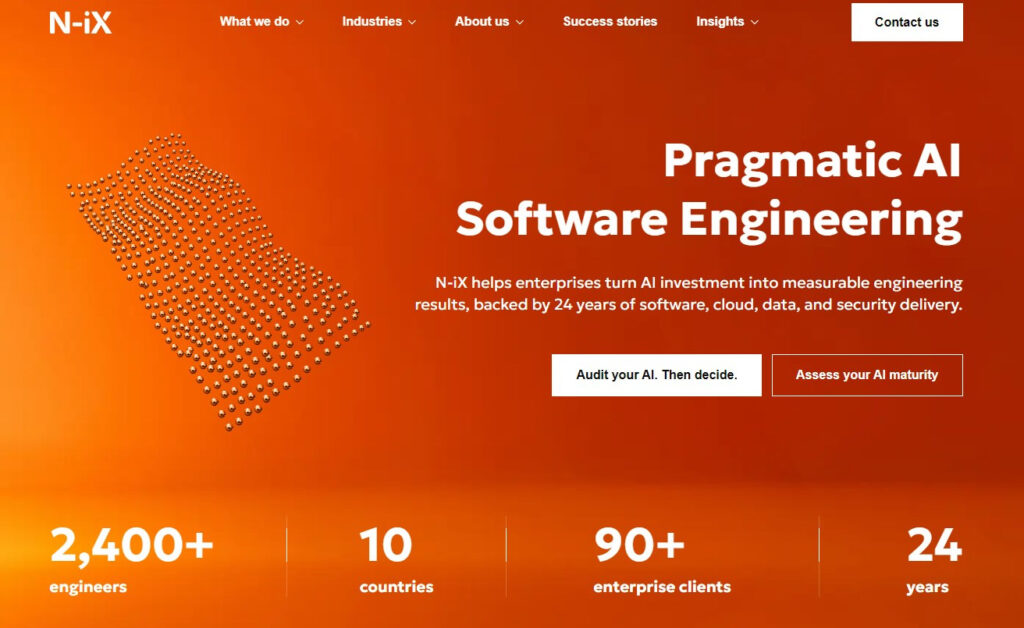
N-iX holds 350 active certifications across Microsoft, AWS, Google Cloud, Palantir, SAP, and Snowflake. The firm became an AWS Premier Tier Partner with an AWS AI Services Competency earned in March 2026.
The company runs a four-phase program for AI-augmented development:
- First, two weeks of assessment. N-iX engineers work inside the client’s codebase with the client’s team. Every AI workflow gets documented. Every gap gets sized. Every opportunity gets costed. If nothing justifies the next step, the engagement stops there.
- Second, four to six weeks of pilot. Three to five workflows run on real code with real engineers against a baseline agreed at the start. The numbers either move or they do not.
- Third, expansion. Workflows that worked get standardized across the organization.
- Fourth, for teams ready to move further, autonomous AI agents inside deployment pipelines and code review cycles.
The firm’s pragmatic AI approach measures everything against the client’s actual codebase and infrastructure before scaling.
- A SaaS company with 250 engineers moved from zero AI usage to 28 percent AI-generated code in six weeks. Code review time dropped 42 percent.
- A US transportation company with 140 engineers saw velocity up 27 percent, test coverage from 55 percent to 81 percent, and hotfix deployment time down 70 percent.
- A housing management platform with 150 engineers cut regression testing from three days to four hours. Incident resolution dropped 87.5 percent.
For enterprises that need AI-generated code measured against real baselines before trusting it, N-iX provides the metrics and the fixes.
3. InData Labs
This firm suits companies where AI-generated data analysis code has created security risks or execution errors.
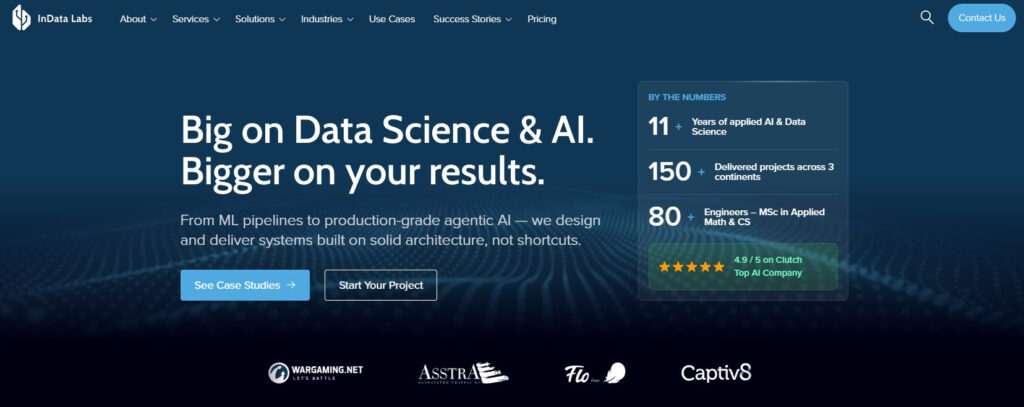
InData Labs has delivered over 200 AI projects since 2014. The firm focuses on predictive analytics and recommendation systems for e-commerce, fintech, and healthcare.
The company follows a structured AI development process. Discovery and planning. Project initialization. Development and iteration. Deployment and launch. Tech support.
Around 85 percent of AI projects fail. InData Labs cites five reasons. Unclear goals. Poor data quality. Lack of skilled talent. Deployment issues where models fail in real-world systems due to integration problems. Organizational resistance.
The firm’s delivery principles address each failure point:
- Business outcomes come first. Start with KPIs and constraints, then pick the tech that delivers impact.
- Fast value delivery happens in weeks, not quarters, with tight iterations and demoable outcomes.
- Production-grade from day one means built for reliability, latency, cost control, and scale.
- Trust by design requires security, compliance, and full transparency.
InData Labs offers three engagement models:
- Time and materials for evolving projects with an adjustable scope
- Fixed price for well-defined requirements
- Dedicated team for long-term collaboration
For companies where AI-generated code creates deployment failures, InData Labs follows a process that catches those failures before production.
4. Ailoitte
This firm suits agencies where AI-generated code broke test suites or created flaky selectors that fail after every UI update.
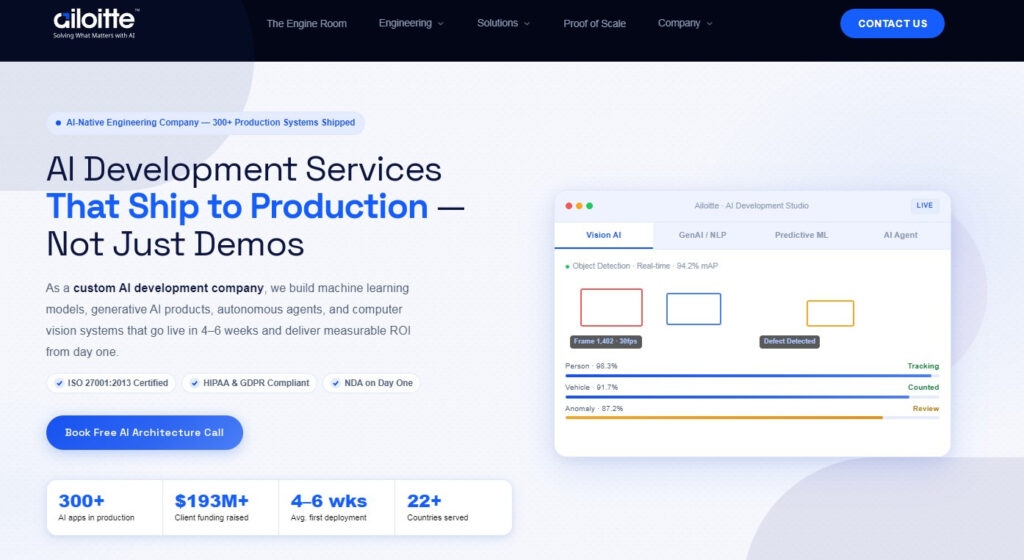
Ailoitte launched an agentic QA pipeline that uses AI to fix broken tests automatically. Traditional test scripts shatter with every UI update. Developers spend sleepless nights debugging false positives.
The agentic QA pipeline works differently:
- Self-healing selectors adapt to DOM changes instantly, reducing maintenance overhead by 99 percent
- AI writes comprehensive test suites directly from user stories or Figma designs
- Visual regression AI, powered by computer vision, catches layout shifts
- Automated OWASP security scanning runs inside every pull request
The firm also builds PaLM AI solutions, including advanced code generation, debugging, and optimization.
For agencies where offshore teams shipped AI-generated code with broken test coverage, Ailoitte provides QA pipelines that fix themselves when the UI changes.
5. Instinctools
This firm suits enterprises where AI-generated code lacks governance, quality controls, and audit trails for regulated environments.
Instinctools has operated for 25 years with over 400 in-house professionals across delivery hubs in Poland, India, LATAM, and Kazakhstan. The firm holds ISO 9001 for quality management, ISO 27001 for data security, and ISO 14001 for environmental management.
The company expanded its enterprise AI capabilities in February 2026 with a proprietary GENiE framework for AI agent implementation. The framework enables the development and coordination of AI agents and multi-agent systems within complex enterprise ecosystems.
The delivery framework includes:
- Architecture validation before any code gets written
- Iterative development with defined checkpoints
- Quality assurance at every stage
- Risk management throughout the process
- Post-deployment monitoring
The CEO Alexey Spas stated: “By aligning AI agent implementation with established engineering governance, Instinctools aims to support enterprise clients operating in regulated and large-scale environments where reliability, transparency, and compliance considerations are critical”.
A client’s co-founder, Patrick Reich, noted: “People at Instinctools are quite tech heads. They have used very advanced libraries, advanced techniques, and advanced coding paradigms. The advantage is that we get reusable code, well-testable code, well-maintained code”.
For enterprises where AI-generated code from offshore teams lacks governance and audit trails, Instinctools brings ISO certifications and a governance framework that regulated industries require.
What Broken AI Code Shares Across Every Case
The Stripe integration broke because the AI wrote new code instead of extending what already worked. The offshore team was gone. The agency had no way to debug. The client lost subscription revenue for a month.
Every broken AI code rescue follows this pattern. The generated code works in isolation. It fails inside existing systems. The original developers cannot be reached. Someone else must reverse engineer the damage before fixing anything.
GetDevDone™ spent four weeks on that recovery. The original UI change should have taken days. The difference between AI-assisted speed and AI-generated disaster is one missing step. Validation against production conditions.
Final Thoughts
The firm above rebuilt a Stripe integration after the AI code broke subscriptions for a month. The client saved about a month of lost revenue and subscriber lockout. The original change, properly scoped, would have cost a fraction with zero downtime.
N-iX measures AI-generated code against actual delivery baselines before anyone trusts it. InData Labs follows a structured process that catches deployment failures before production. Ailoitte fixes broken test suites with self-healing selectors. Instinctools brings governance frameworks for regulated environments.
Ask any AI engineering partner one question before handing over broken code: “Show me a production system you fixed after AI code broke it.” Their answer separates the firms that have rescued real messes from those still learning.